Home Blog Page 39

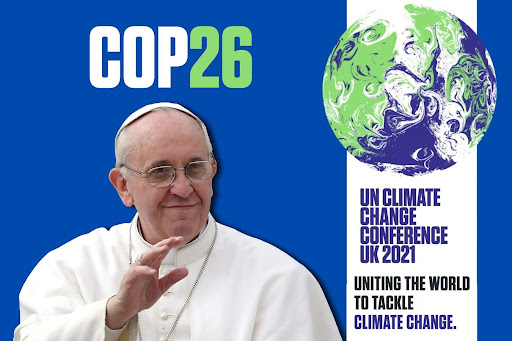
Christians are making an impact at COP26 says campaigner

0

Christians are making their presence felt at the COP26 climate summit in Glasgow with a range of charities, including Tearfund, World Vision and A Rocha being sited within the Blue Zone during the course of the conference.

Laura Young who’s a campaigner with Tearfund and who’s in Glasgow tells Premier she’s very encouraged by the turnout:

“Within the Blue Zone I have bumped into many people from different Christian organisations. It’s just wonderful to know that we are all there with the same message. A lot of us are driven by our faith with our climate action, looking after God’s creation and ultimately, this is a justice issue. This is what really spurs us on. 

“I just really feel there is this hopeful Christian message being put across and you recognise the people that you’ve seen from all those organisations.

“At the weekend, there’s also going to be a big march for the global day of action on 6th November. One of the big things that’s happening in Glasgow is the main march and there’ll be maybe even up to 100,000 people taking part. There’s going to be a faith block, with a big group of us all together.  Tearfund will be there, in our classic yellow T shirts we are really hard to miss! There’s this real group of Christian presences. 

“Over the last year we’ve been doing projects, all to do with climate change. Churches are reaching out, even if they’re not in Glasgow and couldn’t be at COP26. They are saying ‘we want to talk about this in our church, we want to preach about this, we want to pray about this and we want to take action’ and that has just been amazing.”

“For me, you only have to open the Bible on the first page to really hear about God’s creation, hear about our responsibility for God’s creation, to look after it to attend to it. But when we look at some of our destructive practices, we know we’re not doing so.

“This is a justice issue. We’ve been called to love our neighbour and when our neighbours are telling us that they are being impacted by the climate crisis, you can’t really sit still and think I’m just going to continue living a life or not take action against a system that contributes to the climate crisis.

“It’s the fact that we need to love our neighbour and there’s multiple parts of the Bible where God talks about injustice and about us living a life of sacrifice – Romans 12 jumps to mind -about living in a way that is in accordance with His world, His plan for restoration and a just way for everyone.”

SOURCE: PREMIER CHRISTIAN NEWS

Christian reality star gives away all of her possessions following call from God

0

A Christian actor and influencer says she felt prompted by God to give away all her belongings in celebration of her birthday.

Khafi Ekpata announced to her 1.4m Instagram followers that everything, other than her baby boy and the bare essentials were up for grabs to mark the special occasion.

The new mum turned 32 on Wednesday.

Speaking to Premier Khafi, who also presents Premier Gospel’s Naked Love podcast, explained that she felt God speak to her whilst she was in her bathroom the day before her birthday.

“I was just having a shower thinking, what should I do for my birthday? Normally, I don’t really celebrate my birthday so much. I kind of like thank God for the year, and I have some quiet reflection. But, I just heard it very clearly – just give everything away.”

Fans were instructed to direct message the star to receive a location and time to help themselves to anything from clothes and make-up to books and furniture.

When asked how she feels about letting go of so many possessions, Khafi said that although it was nerve-wracking, she was excited to trust God for the next chapter of her life.

“I feel like God is just making way for the new in my life. 

“I’ve acquired all of this stuff over the years and by God’s grace he’s provided and given it to me, but I feel like God was just going to do something new in my life and I’m really excited.”

Khafi, aka A Cup of Khafi says a sermon she heard by American preacher Michael Todd gave her the faith to trust God in her decision to give.

“[The sermon] was all about sowing seeds in all areas of your life. So then when I heard that, I felt like that message had already primed my soul for what God was going to ask me to do,” she said.

Ultimately, Khafi says she hopes her step of faith will bless others: “A lot of the time we think that we don’t have anything to give but actually I feel like God is just showing us that actually even with the little that we have, (you know the parable of the loaves and the fish) he can multiply, he can do good with it. So I just really pray it’s a blessing to others.”

SOURCE: PREMIER CHRISTIAN NEWS

Christian Watchdog Group to Host International Day of Prayer for Persecuted Christians

0

Christians around the world will lift their voices in prayer for their brothers and sisters in Christ facing persecution.

The International Day of Prayer for Persecuted Christians (IDOP) initiative is an annual event launched over two decades ago to remember those who endure persecution and oppression in countries where it is difficult to be a Christian.

In a recent interview with CBN’s Prayer Link, David Curry, president and CEO of the persecution watchdog Open Doors USA, called on churches to participate in the special prayer event this Sunday.

“Over 340 million Christians are persecuted or oppressed because of their faith in Jesus,” Curry explained. “Some of those places like North Korea are exceptionally difficult if you’re caught with the Bible, you may spend the rest of your life in prison or even lose your life.”

“Then there are other places around the world where the Gospel is opposed,” he continued. “You may be harassed and bothered, so there are any number of ways people can be persecuted for their faith.”

Curry, who created the annual World Watch list of countries where Christian persecution is most rampant, further explained that Open Doors has teams placed worldwide to distribute resources to persecuted Christians in need.

“We go and stand with them,” Curry said. “We don’t just airlift it in. We’re going to deliver things to them.”

“Prayer is what it’s all about,” and to “pray is to actively do something to help someone else,” he asserted.

Open Doors USA, which has been around for close to 70 years, will be hosting the event online. Other watchdog groups participating in the event include Release International, Christian Solidarity Worldwide and The Evangelical Alliance.

SOURCE: CHRISTIAN HEADLINES

ACN holds annual #RedWeek against religious persecution

0

The Catholic charity supporting the persecuted Church around the world is focusing this year’s annual campaign on Christian girls and women suffering abduction, forced marriage, forced conversion, and sexual violence.

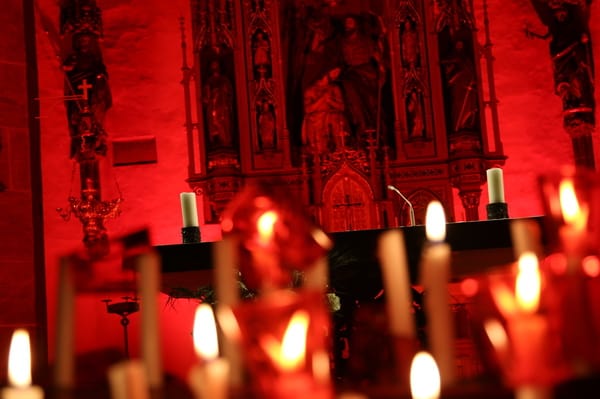
Hundreds of cathedrals, churches, monuments, and public buildings around the world will be lighting up red throughout the week of November 17-24, in an international campaign aimed at raising alarm over the rise of religious persecution.

Titled #RedWeek, the campaign is organized annually in November by the papal foundation Aid to the Church in Need (ACN). It was first launched in 2015 to raise awareness about the persecution of Christians and the need for religious freedom, with Christians gathering all over the world to pray for their persecuted brothers and sisters.

This year’s campaign will kick off in Austria with an event in St. Stephen’s Cathedral in Vienna, followed by similar events in other countries. “A long list of buildings will be illuminated in red, among them the cathedrals of Montreal and Toronto in Canada, the Basilica of Montmartre in Paris, and major buildings in Slovakia,” a press release reports, adding that in Australia schoolchildren in six dioceses plan to wear red clothes during the week, while people in Belgium people will light candles for persecuted Christians.

Religious persecutions rising across the world

Referring to its latest report on Religious Freedom in the World, published earlier this year, ACN recalls that two-thirds of the world’s population live in countries where there are serious violations of religious freedom and that numbers are on the rise, especially in Africa. Violations occur in 42 percent of all African countries, with the most striking cases being in the Sahel region, including Burkina Faso, Mali, and Niger; and in Mozambique, specifically in the province of Cabo Delgado, where terrorist attacks by Islamist militias have escalated dramatically in recent years.

Free exercise of religion, a pillar of liberal democracy

According to Thomas Heine-Geldern, Executive President of ACN, the #RedWeek campaign is sending a clear message of solidarity to persecuted Christians throughout the world: It is “a way to give a voice to our project partners – those who have been tragically marked by the consequences of persecution,” he says. “For us, the free exercise of religion is one of the pillars of liberal democracy. Every form of discrimination based upon religious affiliation must be decisively rejected.”

A focus on forced marriages and conversions 

This year’s #RedWeek campaign will draw attention to the plight of girls and women from Christian and other faith minority communities who suffer abduction, forced marriage, forced conversion, and sexual violence. To this end, on #RedWednesday, 24 November, the UK branch of ACN will present a report titled ‘Hear Her Cries – The kidnapping, forced conversion and sexual victimisation of Christian women and girls’ to the UK Parliament at Westminster. On the same day, the Foreign and Commonwealth government building is slated to be lit red.

SOURCE: By Lisa Zengarini, VATICAN NEWS

Reaching Youth for Christ During Sudan’s Coup

0

When the military closed Khartoum’s airport and disrupted their discipleship training, a generational odd couple from YFC Lebanon improvised and preached to hundreds of students.

At 6:30 a.m. last Monday, John Sagherian and Elie Heneine went down to the lobby of their three-star hotel in eastern Sudan and found a crowd gathered around a TV. Filtering in, they heard the news. When the military closed Khartoum’s airport and disrupted their discipleship training, a generational odd couple from YFC Lebanon improvised and preached to hundreds of students. At 6:30 a.m. last Monday, John Sagherian and Elie Heneine went down to the lobby of their three-star hotel in eastern Sudan and found a crowd gathered around a TV. Filtering in, they heard the news. When the military closed Khartoum’s airport and disrupted their discipleship training, a generational odd couple from YFC Lebanon improvised and preached to hundreds of students.

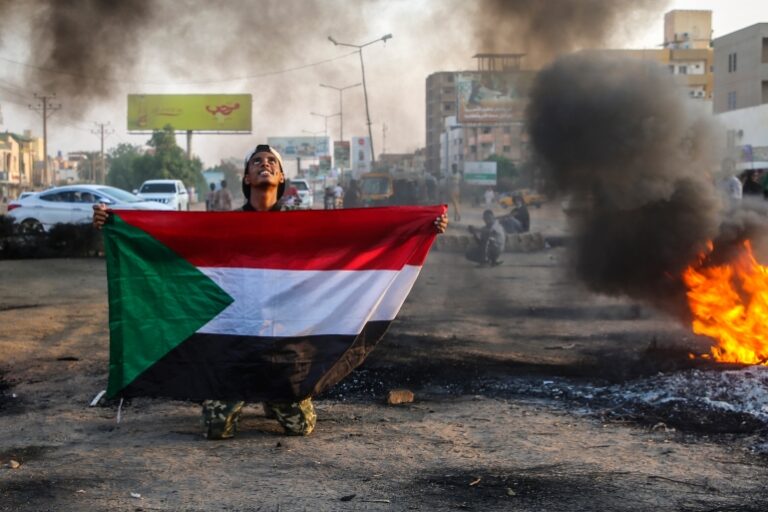
The military had staged a coup in the capital, Khartoum, 90 miles to the northwest.

“Instantly, everything we planned for that day was up in the air,” said Heneine, a 27-year-old staff worker with Youth for Christ (YFC) Lebanon. “Oh well, youth work is very organic.”

Sagherian, the 74-year-old YFC regional director, had long been “dying to visit” Sudan. Two years earlier, he had identified a promising country director named Sabet, who since then had recruited seven other volunteer staff members. Sabet even ignored the capital, concentrating instead on the poorer hinterland.

The Lebanese team of two were finally scheduled to meet their new Sudanese colleagues later that day. As malaria had been among their concerns, they had taken 100 mg of medication every day for two weeks prior. The visa had also been a complication, requiring multiple layers of bureaucracy. But it was the BBC app that now troubled Joy, Heneine’s American wife of five months, as Sudan increasingly filled her news feed.

Heneine himself was at peace. Not only was he used to instability as a Lebanese Christian, but Sabet and others assured them everything was fine—despite the political tumult between the once-cooperating military and civilian leaders.

In 2019, the Sudanese army backed massive protests to overthrow 30-year dictator Omar al-Bashir. A spate of religious freedom reforms replaced his Islamist governance, normalization agreements were signed with the nation’s former enemy Israel, and the US removed Sudan from its list of state sponsors of terrorism.

The economy was struggling, but the World Bank was poised to help. Sudan was almost ready to rejoin the community of nations. But politicians were bickering, and a military coup had been suppressed only one month earlier.

In the background was disagreement over sending Bashir to the International Criminal Court to be tried for war crimes in Darfur. Deeper still were issues of army control of large sectors of the economy. And at an unspecified but fast-approaching date, the transitional Sovereign Council was supposed to switch to civilian leadership.

Two days before the coup, the YFC team had traveled three hours over bumpy roads with multiple checkpoints to reach Wad Madani, Sudan’s ninth-largest city. Sabet’s youth office was located in an evangelical school, and he’d invited Sagherian to preach to the local congregation that Sunday evening. When the military closed Khartoum’s airport and disrupted their discipleship training, a generational odd couple from YFC Lebanon improvised and preached to hundreds of students. At 6:30 a.m. last Monday, John Sagherian and Elie Heneine went down to the lobby of their three-star hotel in eastern Sudan and found a crowd gathered around a TV. Filtering in, they heard the news. When the military closed Khartoum’s airport and disrupted their discipleship training, a generational odd couple from YFC Lebanon improvised and preached to hundreds of students.

With men sitting up front on plastic chairs and women behind, about 30 people filled the three-walled, tin-roofed structure. Such impromptu invitations were not unusual for the still-active senior, so Sagherian pulled out a message he had given often to Lebanese, Syrian, and Egyptian youth.

The title proved prophetic: “Why Is God Doing This to Us?”

“Do we become angry and bitter or say, ‘What now, Lord?’” Sagherian recalled preaching. “And then the coup happened [the next day].”

He spoke from experience. Ten years earlier, his beloved wife, Nancy, died of cancer. Her acceptance of God’s will in their final weeks together inspired another decade of her husband’s ongoing service.

Eventually, the team learned that Christians in Wad Madani had joined their fellow Muslim citizens in overwhelmingly rejecting the coup. But first, YFC had to reach the local believers.

A group of 35 leaders from the three evangelical churches in the city had been prepped for their arrival. Sabet went to learn firsthand whether the training sessions would still be held; it was two hours of silence before he returned.

“They are waiting for you,” he said.

Sabet hailed a tuk-tuk, one of the three-wheeled auto rickshaws that serve as local taxis. The three leaders joined five others and a baby goat sitting on the rail, knees knocking, continuously jostling, as the 15-year-old driver navigated the poorly paved road.

“That was a lot of human beings, and I am like five people,” said Heneine. “It was the workout of our lives just to hold on.”

That was only the start. Moving across town, they witnessed protesters breaking up the sidewalk to pile makeshift barriers to block traffic. They circled the neighborhood looking for a thruway, only to turn back and discover a new one. Eventually they pleaded as “one of the people” and were allowed passage.

But there was no animosity, said Heneine. Unlike in his native Lebanon, there was incredible unity among the Sudanese, with none opposed to anyone except the coup leaders.

And they were also organized. The Sudanese would go to their jobs, except they would not work—answering the call for civil disobedience. And at noon they would gather in the streets, block roads, and burn tires. Even the bread lines, an unfortunate consequence of the economic stress, would disappear.

Sagherian instructed the youth workers from Psalm 78: David led the people with competence and integrity of heart. It appeared evident all around.

By Tuesday (October 25), the YFC team grew to recognize the rhythms of the protest and how to best move around. By the afternoon, the government had cut off phone and internet service across the nation to disrupt the protest movement. It also disrupted YFC’s best-laid plans.

So they continued to disciple Sabet and his seven staff members and resigned themselves to a reduced training schedule. Now relaxed, they enjoyed a fish lunch with lemonade on the banks of the Blue Nile. And they took a PCR test, ready to fly home the next day—only to learn on Wednesday that the airport had been closed.

Stuck, the YFC leaders scrambled and called for a youth meeting in a poor village on the outskirts of town the next evening.

Sabet worked with the headmaster, who about a decade earlier had become the neighborhood’s first convert to Christianity. But he wasn’t the last. Sharing the gospel, this man gathered new believers into a mud-hut home fellowship. Then he built a church; then, a school. And now he called the 95 percent Muslim student body to attend a youth rally—and told Sagherian he should preach clearly about Jesus.

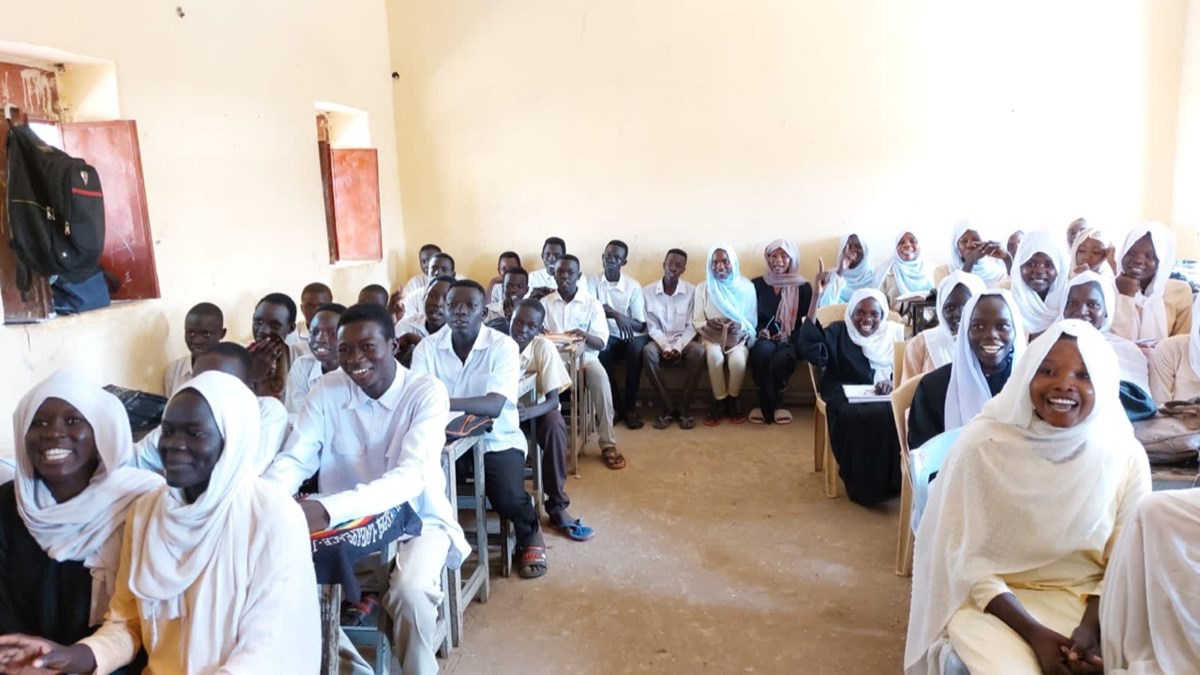
Students in a classroom in al-Thawra near Wad Madani, Sudan
IMAGE COPYRIGHT / AFP/ Image: John Sagherian

Students in a classroom in al-Thawra near Wad Madani, Sudan

Raised as a pastor’s kid in the Armenian evangelical community of Lebanon, Sagherian was familiar with altar calls. He assumed national leadership of YFC in 1974, becoming the Middle East and North Africa regional director in 2010. From decades of ministry experience among mostly Christian-background students, he expected maybe 100 kids to show up. It would be incredible if five gave their lives to the Lord.

Over 1,000 filled the dirt-covered schoolyard grounds.

Sagherian adapted his usual YFC anecdotes:

Imagine you had to swim from the Red Sea coast to India. Some of you might get farther than others. But none of you would make it. Your good lives cannot satisfy God.

Imagine if I suddenly had the mind of Ronaldo controlling me. I’m 74, but I’m darting all over the soccer field, scoring goals. This is what happens when Jesus comes into our lives: We now satisfy God.

He asked those who wanted to give their lives to Jesus to stand up. Nervous, one did here, then there. But before long, the entire student gathering was upright.

Wait—something was off. Sagherian pressed the importance of the decision. Having the students sit down, he asked them this time to raise their hands. Perhaps more aware, 80 percent did so.

God knows the heart, he counseled himself. And he remembered his father’s words from many years ago: “You talked to them about God. Now talk to God about them.”

Heading back to the hotel, the YFC team learned the airport would open the next day, but nothing was certain. They woke at 5:30 a.m. and providentially arranged a taxi. Entering Khartoum, they saw lines of well-armed police officers. Saturday was to be a million-man demonstration, and the security forces were preparing. (To date, 15 protesters have been killed.)

Another PCR test was required at the airport, but the office was closed. Somehow, the man in charge agreed to come, two hours later than promised. The clock was ticking. But the nose swab’s negative results were returned in five minutes—surely an example of Sudanese corruption but perhaps also of God’s provision.

The airport was sweltering, packed with people anxious to leave the country. But boarding was smooth, and after an overnight layover in Addis Ababa, their Ethiopian Airlines red-eye flight landed in Beirut.

“We were living out the promises of God,” said Sagherian. “I never felt we were in danger, and we learned that so many people were praying for us.”

They asked instead for a shift in focus.

“We were two people who did our ministry and left, while Sudan continues to fight with itself,” said Heneine. “Be praying for them.”

Sabet told them that he has always been free within church buildings. But only since the revolution had he been able to minister in the public square. “People don’t care about religious background any longer,” he told them, and his good reputation in the village earned him much trust.

But Sabet doesn’t know what will happen after the coup.

In a potentially ominous sign, military leaders have released some of Bashir’s top officials from jail. International actors continue to mediate, while the deposed prime minister holds his ground.

So much is at stake for the Sudanese.

But for the Lebanese, who simply expected a normal time of training youth, the experience was transformative. Sagherian choked up, recalling the opportunity to share the gospel with so many Muslim youth. Heneine learned how to “wait on the Lord” from his senior colleague.

“God moved circumstances and people, putting us in places we couldn’t have imagined,” said Heneine. “It was like a well-played chess match, and God won.”

SOURCE: CHRISTIAN HEADLINES

‘Make it a Christian town’: the ultra-conservative church on the rise in Idaho

0

Increased influence of Christ Church, whose leader wants to create US ‘theocracy’, comes as social conservatives aim to gain tractionJason Wilson in Moscow, Idaho.

A Guardian investigation has revealed that a controversial church whose leader has openly expressed the ambition of creating a “theocracy” in America has accumulated significant influence in the city of Moscow, Idaho.

Christ Church has a stated goal to “make Moscow a Christian town” and public records, interviews, and open source materials online show how its leadership has extended its power and activities in the town.

Church figures have browbeaten elected officials over Covid restrictions, built powerful institutions in parallel to secular government, harassed perceived opponents, and accumulated land and businesses in pursuit of a long-term goal of transforming America into a nation ruled according to its own, ultra-conservative moral precepts.

The rise of Christ Church may be playing out in a small Idaho city but it comes at a time when the US is roiled by the far right, including Christian nationalism, and when social conservatives are seeking to roll back basic tenets of US life such as legal abortion, as well as dominating powerful national institutions, such as the supreme court.

While the church’s previous controversies have centered on its founder and pastor, Douglas Wilson, a new generation of male church leaders – including Wilson’s son – have found ways to expand the church’s reach in Moscow and beyond, even gaining footholds in mainstream popular culture in the broader US.

In recent months, Christ Church has advocated for resistance to Covid mandates in Moscow, and Wilson has attempted to give theological ballast to opposition to restrictions and vaccination programs, as well as warning of political violence.

Last month, a video version of a post by Wilson at his well-read blog was removed from YouTube. The blogpost, entitled “A Biblical Defense of Fake Vaccine IDs”, was based on a conspiracy theory asserting that the vaccine response was a “power play” on the part of the Biden administration, which intended to leave the restrictions in place permanently.

Wilson further claimed that “we are not yet in a hot civil war, with shooting and all, but we are in a cold war/civil war” and urged readers to “resist openly, in concert with any others in your same position”, claiming that this would not be “rebellion against lawful authority” but “an example of a free people refusing to go along with their own enslavement”.

The post was met with outrage, including from other prominent evangelicals.

That was not the only time that Wilson’s activities and positions have led to criticism from other evangelicals, and associations with Wilson have led to crises in other churches.

In recent months, members and clergy resigned from Minneapolis’s Bethlehem Baptist church, and staff resigned from its associated Bethlehem College and Seminary (BCS), in part over the appearance of newly appointed BCS president Joe Rigney on Man Rampant, a video series hosted by Wilson and streamed on platforms including Amazon Prime. The show promotes Wilson’s long-held position that men need to assert themselves in society.

Christ Church was founded in Moscow in the 1990s, and experts who have studied the church estimate the size of the congregation and its offshoot churches at about 2,000, or 10% of the city’s total population.

But they also say that the church is increasingly drawing people to the area who are attracted to the idea of northern Idaho as a conservative “redoubt” against American modernity, and by the church’s “reconstructionist” position, which holds that the world will need to be governed according to their interpretation of biblical morality before Christ returns to earth.

Christ Church’s previous controversies have garnered national attention.

Recent reporting focused attention once more on the church’s – and Wilson’s – handling of a series of sexual abuse cases, and the theological subordination of women.

In 2005, Wilson asked a judge for leniency in the case of Stephen Sitler, a former student at a Christ Church-aligned college, New Saint Andrews College (NSAC). Sitler was at that time convicted of sex offenses involving children.

After his release on probation in 2007, Sitler was married in Christ Church in 2010, by Wilson, to a woman who, by Sitler’s and her account, had been introduced to him by Edwin Iverson, then a Christ Church elder and now pastor of a Council of Reformed Evangelical Churches (CREC) church in Colville, Washington.

Wilson has faced scrutiny over other positions.

In the early 2000s, Wilson received criticism over a book, Southern Slavery as it Was, which he had co-written in the previous decade with J Steven Wilkins. Wilkins is a Louisiana pastor who was a co-founder of the neo-Confederate organization, the League of the South. His church is a member of Wilson’s congregational umbrella group, the CREC.

The book depicted slavery in the antebellum southern United States as “a relationship based upon mutual affection and confidence”, and argued that the enslaved enjoyed “a life of plenty, of simple pleasures, of food, clothes, and good medical care”.

Wilson has repeatedly disavowed any interest in national electoral politics, but Christ Church’s eventual aim is what Wilson explicitly describes in a 2016 book as “theocracy”, or “a network of nations bound together by a formal acknowledgement of the lordship of Jesus Christ”, as opposed to secular society ruled by “civil governments, [which] are in necessary degrees satanic, demonic, and influenced by the god of this world, who is the devil”.

These beliefs have led Christ Church into conflicts with local government, but additionally, Wilson and other Christ Church members have founded a range of local and national institutions which are affiliated with or sponsored by the church.Advertisement.

Christ Church itself is an unincorporated nonprofit, which means that it is not obliged to provide details of its finances to government authorities. Many entities associated with the church are either also unincorporated, like the Logos School, or, like publisher Canon Press, are operated by a network of limited liability companies (LLCs) which are similarly limited in their accountability.

But insiders who spoke on condition of anonymity said that all members tithe 10% of their household income, and wealthier members are expected to make an even larger contribution.

Within a network of educational institutions, publishing houses, churches, and national associations that Wilson has founded or led, a small number of men, from a small number of families, have come to exert significant power within the organisation and Moscow.

Not least among these is Wilson’s own family, with him as its head.

At NSAC, for example, the college president is Wilson’s son-in-law, Ben Merkle. Another son-in-law, Luke Jankovic, sits on the board of trustees, as does Wilson himself and Christ Church’s associate pastor, Toby Sumpter.

Douglas Wilson is also on faculty at NSAC, and is listed as a senior fellow in theology. Also on faculty are his son Nathan (ND) Wilson, a fellow of literature; and his brother, Gordon Wilson, a self-described “young earth creationist” who believes that God created the earth in seven days, is senior fellow of natural history.

According to tax filings, Merkle and Gordon Wilson each draw salaries from the college, which lists tuition and costs for undergraduate students at $19,900 per year.

Merkle, Jankovic, and all three Wilson men are also elders at Christ Church, along with a founding director and former trustee at NSAC, Moscow resident Andrew Crapuchettes.

Until June 2021, when the company was acquired by a competitor, Crapuchettes had been chief executive of Moscow’s largest private employer, EMSI, for more than 19 years.

During that period, EMSI was a major employer of NSAC graduates. According to LinkedIn data, there are 55 current employees at EMSI who are NSAC graduates, from a college which has graduated only 635 people throughout its history.

In addition, a number of Christ Church elders hold senior positions at EMSI. They include Luke Jankovic – the NSAC trustee who is Wilson’s son-in-law – who is now executive vice-president of higher education.

Also, EMSI’s chief operations officer and chief financial officer is Timothy van den Broek, a teaching elder at Trinity Reformed church, Christ Church’s suburban offshoot.

Van den Broek began his career at EMSI immediately after graduating from NSAC, and he sits on the boards of church-aligned businesses and organizations, including their charity, the Hope Center, and Classic Learning Initiatives, which aims to devise alternative standardized testing for students at Christian private schools who wish to attend private Christian universities like NSAC.

Since his departure from EMSI, Andrew Crapuchettes has started a new venture, a jobs website called Red Balloon, which advertises itself as connecting “employers who value freedom with employees who value it too”, in “a world beyond cancel culture, where employees are free to work … without fear that they will find themselves on the wrong side of their employer’s politics”.

Many of the website’s initial clients appeared to be either church run or founded organizations, or companies belonging to other church members.

Now, Crapuchettes has branched out into property development, and this year won approval from Moscow city council for the “annexation” of 27 acres of land on Moscow’s south-western edge for a new, 109 unit subdivision called Edington.

A local businessman, who spoke on condition of anonymity, said that the church already had a disproportionate presence in the downtown area, and that developments like Edington were evidence that “they are trying to attract more people here”.

He added that the church’s anti-mask and anti-vaccination positions, as well as its attempts to “take over local institutions” like a food co-op, had polarized the community.

He also referred to an ad for New Saint Andrews College that had been seen as transphobic by many in Moscow had “galvanized the town against them”. He called it a demonstration of the church’s preparedness “to throw red meat and recruit on the basis of hate”.

In response to detailed emailed questions about various aspects of Christ Church’s operations, Douglas Wilson did not offer any specific response, but wrote that the Guardian’s “approach illustrates an absurd fixation and anti-church bigotry that we have come to expect from certain elements of the leftist media”.

Asked about EMSI’s hiring practices under his leadership, Andrew Crapuchettes wrote that: “Under my watch, EMSI grew into a global company with offices on two continents, and in an ever-tightening labor market, we hired talent wherever we could find it, including from the 3 local colleges – Washington State, University of Idaho and New Saint Andrews.”

SOURCE: THE GUARDIAN

75 Percent of Evangelicals Believe ‘God Has Granted America a Special Role’ in History

0

A majority of Christians say they believe the United States has a God-ordained “special role” in history and that the nation has always been a force for good in the world, according to a new survey.

The Public Religion Research Institute (PRRI) poll of 2,508 Americans, released Monday, found that 75 percent of White evangelicals, 67 percent of Black Protestants and 55 percent of “other Christians” believe “God has granted America a special role in human history.” Although White evangelicals are the religious group most likely to agree with the statement, the poll found a decline on the topic since 2013, when 84 percent of white evangelicals agreed with the statement.

The survey also found a wide political divide on the issue, with twice as many Republicans (68 percent) as Democrats (33 percent) agreeing with the statement.

Among all Americans, 44 percent agree – a 20-point drop from 2013, when it was 64 percent.

“Significantly fewer Americans today believe that God has granted America a special role in human history,” a PRRI analysis of the survey said.

The poll found more consensus on whether “America has always been a force for good in the world,” with 74 percent of all Americans – including 92 percent of Republicans and 67 percent of Democrats – agreeing with the statement.

Among various religious groups, 88 percent of White evangelicals, 69 percent of Black Protestants and 71 percent of “other Christians” agree with the statement.

But on another topic – pride in being an American – PRRI found another political divide. Nearly six in 10 Americans (58 percent) say there has never been a time when they were not proud to be an American. Three-quarters (76 percent) of Republicans but 45 percent of Democrats agree with the statement. A majority of White evangelicals (70 percent) and Black Protestants (64 percent) agree with the statement.

The survey was conducted Sept. 16-29.

SOURCE: CHRISTIAN HEADLINES

Braves’ Swanson: ‘God’s Always Got a Plan’ that ‘Will Never Fail You’

0

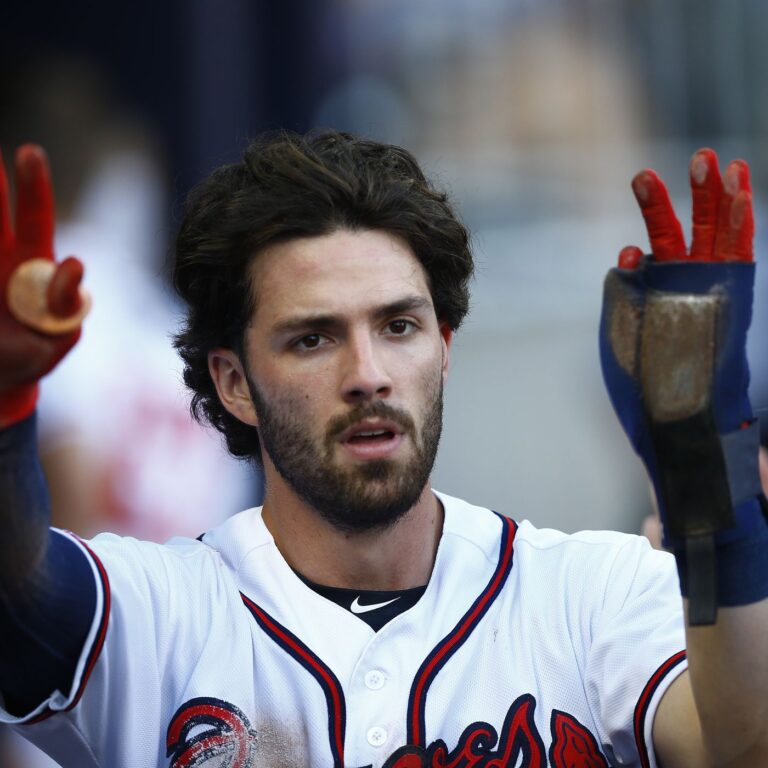
The Atlanta Braves’ Dansby Swanson helped his team win Game 4 of the World Series Saturday and then told a national television audience how his faith in God has given him peace amidst difficult circumstances.

Swanson’s solo home run in the seventh inning tied the game and sparked a rally that lifted the Braves to a 3-2 win over the Houston Astros.

Swanson, who plays shortstop, told a Fox TV audience that his Christian faith kept him grounded when he was traded from Arizona to Atlanta in December 2015 – only six months after being selected by the Diamondbacks as the No. 1 overall pick in the Major League Baseball draft.

“I’m just so thankful to be here,” a smiling Swanson said. “I really can’t say it enough. Being traded over here – at the time, I didn’t understand it. But God’s always got a plan. And if I’ve learned one thing is having faith in that plan will never fail you. And it’s one of the best things that’s ever happened to me.”

Swanson, who grew up in Georgia and played college baseball at Vanderbilt University, said he’s enjoyed living in his home state.

“Being here, being able to see my family as much as I do, watching my nephews grow up. If I didn’t get traded here, I would never have ever met Mallory,” he said of girlfriend Mallory Pugh, a professional soccer player. “I mean, you just start stacking things on top of each other, and it’s truly a blessing to be here in this city. I love this city. I’m a diehard Falcons fan. I’m a diehard Hawks fan. And obviously, I’m a diehard Braves fan.”

Atlanta leads the best-of-seven series 3-2. Game 6 is scheduled for Tuesday in Houston.

The Braves are trying to win their first World Series since 1995. They were swept by the New York Yankees during their last World Series appearance in 1999.

SOURCE: CHRISTIAN HEADLINES

‘God can accomplish great things’: North Carolina church packs 50,000 meals to send to Zambia

0

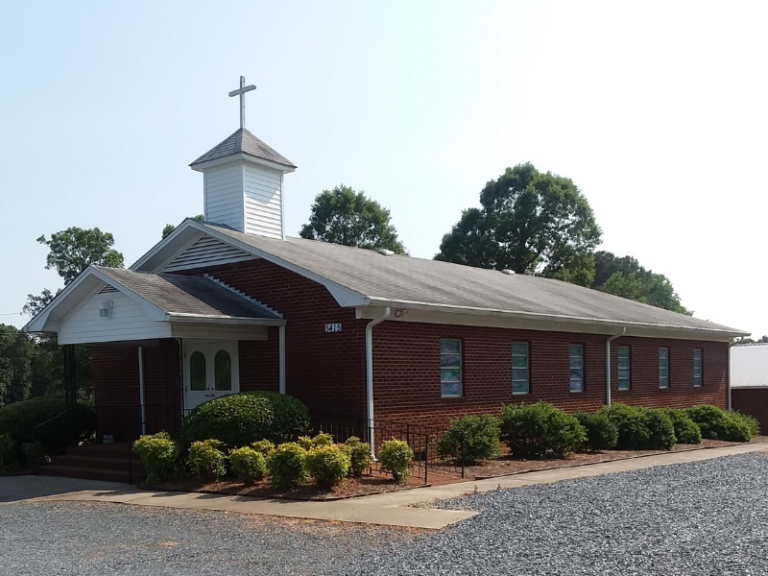
A Baptist congregation in North Carolina packed 50,000 meals over the course of two days to help the needy in Zambia.

The Greenville-based Unity Church, which belongs to the National Association of Free Will Baptists, organized volunteers to pack 50,000 meals on Friday and Saturday.

Kevin Justice, pastor of worship and administration at Unity Church, told The Christian Post that the idea for the charitable event came from their senior pastor.

“Lead Pastor Jeff Manning realized a renewed burden to allow the Lord to work through our congregation to ‘do something’ that impacts our community and the world for Christ,” Justice said.

“In researching various outreach opportunities, he found Kids Around the World, a nonprofit based in the Chicago area. One of their programs, OneMeal, provides a turnkey system for groups to pack meals to be sent to centers around the world that feed children and share the message of the Gospel.”

The meals, which were packed over the weekend, were picked up from the church on Monday to be shipped to the Chicago area and, from there, to Zambia.

According to Justice, the 50,000 meals will be sent to a center in Zambia that is overseen by the OneMeal program that provides an estimated 14,000 meals a day to children in need.

Justice told CP that he hoped that, by participating in the charitable event, his congregation would develop “a desire to make a difference in our world by meeting needs and sharing the Gospel,” “a realization that God can accomplish great things and allows us to be a part of the process,” and “a sense of community while we serve together.”

Although this was the first time that Unity Church had done such a charitable event, many churches across the United States have done similar meal-packing efforts. Although this was the first time that Unity Church had done such a charitable event, many churches across the United States have done similar meal-packing efforts.

For example, Hope City Church of Joplin, Missouri, packed 40,000 meals at an event last December on behalf of the charity Watered Gardens Ministries.

In an interview last year, Hope City Lead Pastor Cody Walker told CP that they “wanted to give our people an opportunity this season to impact our local community.”

“In a season where it can be easy to give our attention and focus to things, we wanted to focus on people. Instead of having a typical worship gathering, we spent most of our time packing meals that will help feed hungry families,” Walker said.

“We know everyone needs two things: food and hope. We hope these meals will be able to provide both for people who need to know they are not forgotten or alone. Our people at Hope City know we are all in the same boat and serving others is at the heart of the Gospel.”

SOURCE: CHRISTIAN POST

Haiti gang seeks $1 million per person for kidnapped Christian missionaries

0

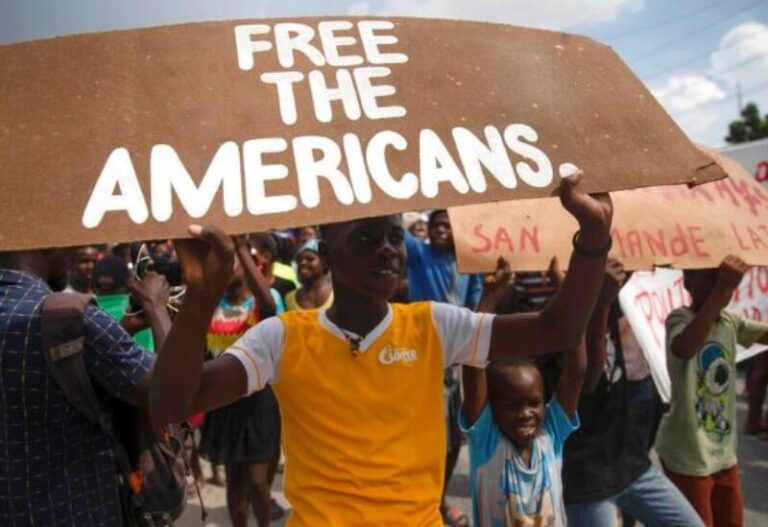
A Haitian gang that kidnapped a group of American and Canadian missionaries is asking for $17 million – or $1 million each – to release them, according to a top Haitian official.

Justice Minister Liszt Quitel told Reuters that talks were under way with kidnappers to seek the release of the missionaries abducted over the weekend outside the capital, Port-au-Prince, by a gang called 400 Mawozo.

The minister confirmed the ransom fee, telling Reuters: “They asked for $1 million per person.” The fee was first reported by the Wall Street Journal earlier in the day.

CNN reported earlier on Tuesday the kidnappers first called Christian Aid Ministries – the group to which the victims belonged – on Saturday and immediately conveyed the price tag for the missionaries’ release.

The FBI and Haitian police were advising the group in negotiations, the minister said.

Several calls between the kidnappers and the missionary group have taken place since their disappearance, the minister told CNN.

The Ohio-based Christian Aid Ministries called for prayers for the “Haitian and American civil authorities who are working to resolve this situation.”

Among the 16 Americans and one Canadian are five children, including an 8-month-old baby, the missionary organization said.

They were abducted in an area called Croix-des-Bouquets, about 8 miles (13 km) outside the capital, which is dominated by the 400 Mawozo gang.

The U.S. government is “relentlessly focused” on the kidnapping and in constant communication with Haitian police and the missionaries’ church, Secretary of State Antony Blinken told journalists in Quito, where he met with that country’s president and foreign minister.

“Unfortunately, this is also indicative of a much larger problem and that is a security situation that is quite simply unsustainable,” Blinken said, referring to gangs that he said control parts of Port-au-Prince.

The FBI said on Monday it is part of a U.S. government effort to get the Americans involved to safety.

Five priests and two nuns, including two French citizens, were abducted in April in Croix-des-Bouquets and were released later that month.

Quitel told the Wall Street Journal that a ransom was paid for the release of two of those priests.

Kidnappings have become more brazen and commonplace in Haiti amid a growing political and economic crisis, with at least 628 incidents in the first nine months of 2021 alone, according to a report by the Haitian nonprofit Center for Analysis and Research in Human Rights, or CARDH.

Haitians mounted a nationwide strike on Monday to protest gang crime and kidnappings, which have been on the rise for years and have worsened since the July assassination of President Jovenel Moise.

Shops reopened on Tuesday in Port-au-Prince and public transportation started circulating again.

Transport-sector leaders had pushed for the strike, in part because transit workers are frequent targets of gang kidnappings.

Kidnappings in Haiti have rarely involved foreigners.

The victims are usually middle-class Haitians who cannot afford bodyguards but can put together a ransom by borrowing money from family or selling property.

The growing crisis in Haiti has also become a major issue for the United States. Thousands of Haitian migrants arrived at the U.S.-Mexico border last month, but many were deported to their home country shortly afterward.

SOURCE: PREMIER CHRISTIAN NEWS