Home Blog Page 45

Hundreds Get Saved During First Night at Mario Murillo’s Tent Crusade

0

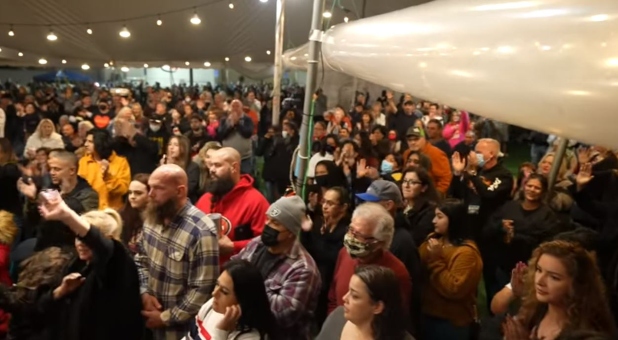
“The Jesus Movement of the new millennium is happening right before your eyes,” evangelist Mario Murillo proclaimed as hundreds flooded the altar during the first night of his Living Proof Sacramento Tent Crusade Sunday night in California.

“I don’t want to lose this harvest. I want every single one of you who are on your feet that wants me to pray with you, that wants this miracle, to walk to the front and come to Jesus.”

And walk the aisle they did. Watch this amazing altar call from this tent crusade and see people come to Christ in droves as Murillo prays them into the kingdom.

Following the prayer, Murillo told the crowd: “You have just made a decision that you will never regret. You will live the rest of your days in the power of the prayer you just prayed. You’re going to see cancer healed and sickness will leave your body. If we had a dead corpse up here and it came to life, it would not be near the miracle that God just gave you now.”

SOURCE: CHARISMA NEWS

‘Be Prepared for Persecution,’ American Evangelist Warns Following Arrest for Preaching Against Homosexuality in London

0

An American evangelist who was recently arrested in London for preaching against homosexuality is warning the church of growing religious persecution, including the suppression of free speech.

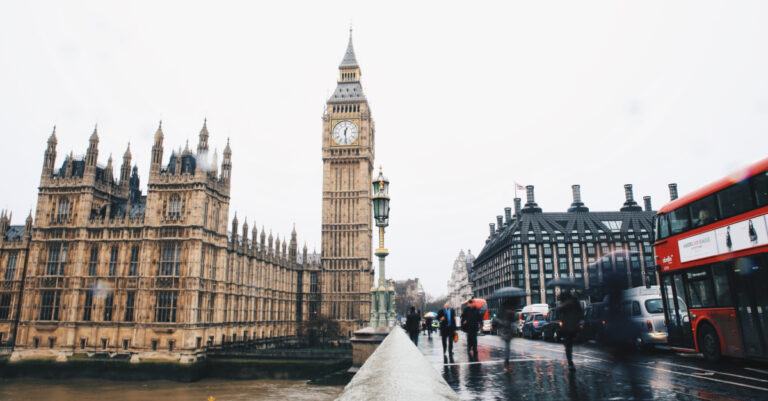
Ryan Schiavo, who leads Last Days Pulpit Ministry, was arrested in London on July 22 for preaching that homosexuality is a sin.

Schiavo is an American pastor who often travels to London to minister to the British youth in the public square. At the time of the arrest, Schiavo was preaching the Gospel while also addressing additional topics such as homosexuality and transgenderism.

“I was preaching the Gospel on the streets as I frequently do, but it was about a 30-minute message, and in the course of a long message, I can touch on many topics that I believe are pertinent,” Schiavo toldThe Christian Post.

“At one point, I talked about the issue of homosexuality and transgenderism,” he continued. “I said that homosexuality is a sin; I talk[ed] about how it’s destructive, and the damage the transgender agenda is doing to children right now in the schools because it’s being pushed on children at a very young age here.”

During the message, Schiavo also contended that “the churches that have rainbow flags on them” were “not real churches.”

In response to his remarks, a young woman believed to be a lesbian called the cops on the American evangelist.

According to video footage documenting the arrest, Schiavo was alleged to have violated Section 4A of the Public Order Act.

The law states that a “person is guilty of an offense if, with intent to cause a person harassment, alarm, or distress, he — (a) uses threatening, abusive or insulting words or behavior, or disorderly behavior, or (b) displays any writing, sign or other visible representation which is threatening, abusive or insulting.”

“It is an honor to suffer for Jesus Christ,” Schiavo declared as Metropolitan Police came to arrest him. He also asserted that “God is going to judge this country so severely” for embracing the LGBT ideology.

Schiavo told The Christian Post that he was placed in a jail cell “for 10 hours and given a mental health evaluation by the National Health Service before being released in the middle of the night.”

During the mental health evaluation, which lasted 30 minutes, Schiavo was asked “personal questions” about his family, work and physical well-being. He contended that the evaluation was utilized as an effort to “convince me not to talk about homosexuality in public anymore.”

“He (the mental health evaluator) wanted me to affirm him and just say, ‘OK,’ and agree, and I never did,” Schiavo told The Christian Post.

Schiavo warned that the use of the evaluation gave further evidence that “things are getting very bad” in the U.K. when it comes to religious freedom and freedom of speech.

“All these institutions are working together with each other; they’re anti-Christ,” Schiavo asserted. “It’s time for the church to wake up and to be prepared for persecution.

He also noted that “Freedom of speech and expression are very much under attack in the Western world, and I’m concerned that many of these Western countries are becoming communist.”

While Schiavo was not formally charged with a crime, his arrest places him “in the national police records for three years.”

At the present time, he is working with the U.K.-based legal organization Christian Legal Centre to overturn the matter.

SOURCE: CHRISTIAN HEADLINES


Why the Power of God Must Be Displayed for Effective Evangelism

0

There is a huge emphasis in the evangelical church on evangelism, church planting and the like.

This is good since the church should never be separated from its mission of proclaiming Jesus to this lost world.

In light of this, I believe the church will fall short of its goals unless we incorporate signs, wonders and miracles into our methodological norm as we evangelize. The Scriptures are replete with passages equating the knowledge of God with His display of the supernatural. For example, the Old Testament is full of examples such as Abraham and Sarah having a child past the normal biological age, Moses doing signs and wonders in Egypt so that His power may be demonstrated to the world (Rom. 9:17) and Elijah calling down fire from heaven to demonstrate that the Lord is the true God (1 Kings 18).

What about the New Testament? First of all, Jesus told His disciples that they would receive power to be His witnesses (Acts 1:8). This power was primarily centered on the ability to be a witness to the resurrection of Christ. The biblical narratives after Acts 1:8 show that the primary reason for this power was so the apostles would demonstrate the Word by healing the sick and performing miracles.

Acts 5:12-16 connected extraordinary signs and wonders to God. This added multitudes of believers to the Lord. In Acts 8, we see how Philip was able to turn the whole city of Samaria to the Lord by moving in the power of signs, wonders and miracles. Paul, the apostle, also utilized this method of evangelism. Acts 14:3 says that the Lord bore witness to the word of His grace by granting signs and wonders to be done by their hands (Paul and Barnabas). In Acts 19:11-12, it says that God did extraordinary miracles by the hands of Paul while he was ministering in the city of Ephesus.

Later on, as recorded in Acts 28:1-10, Paul was able to bring the gospel to the whole island of Malta after he healed the chief man of the island, whose name was Publius. (This happened after God supernaturally spared his life after a poisonous snake, which was supposed to kill him, bit him.) In 1 Corinthians 2:1-4, Paul said that when he preached the word, there was always a demonstration of the Holy Spirit and power so that their faith would not rest on the wisdom (or rhetoric) of men but the power of God. The supernatural move of the Holy Spirit likely was a normal occurrence in the life of all the early churches as we read in Paul’s letter to the Galatians (Chapter 3:5). Paul said that God supplied their church with the Spirit and miracles through the hearing of faith.

Furthermore, in Hebrews 6:5, it says that believers during those days experienced the powers of the age to come. (If we consider the context of this book as well as the entire New Testament, this passage seems to be referring to the power of the invisible, supernatural God, intervening in the lives of men through miraculous healings, supernatural signs and wonders.)

Hebrews 2:4 also says that the Lord bore witness to the word from the Lord Jesus and His apostles by granting them signs, wonders and various miracles and gifts of the Holy Spirit. The apostles of the first-century church needed to depend upon the power of signs and wonders to preach the Word of God. How much more should we depend upon this to convince this present generation of the reality of Jesus.

Furthermore, all through the four Gospels, we see how Jesus moved in the word of knowledge, word of wisdom, the gifts of healing and the working of miracles to demonstrate that the Father sent Him into the world (John 5:36-37). In John 9:1-4, Jesus said that a man was born blind so that He would be able to demonstrate the works of God through the healing in this man.

In John 4, we also read how Jesus operated in the prophetic gifts of the word of knowledge to convince the woman at the well that He was indeed the Messiah. In John 11:42, we also read that Jesus prayed and thanked the Father in public for what He was about to do when Jesus raised Lazarus from the dead. This was to demonstrate that the Father sent Him. If Jesus, the perfect God-Man, needed the miraculous (even though He was the greatest preacher the world ever heard), how much more does the present-day church need to depend upon the power of God to spread the gospel of Christ.

This present secular humanistic society we live in will not be convinced merely by good rhetoric and visceral worship experiences during a Sunday morning service. They need to experience the glory, presence and power of God almighty!

SOURCE: CHARISMA NEWS

Missing Catholic Girl in Pakistan Depicted as Married Muslim

0

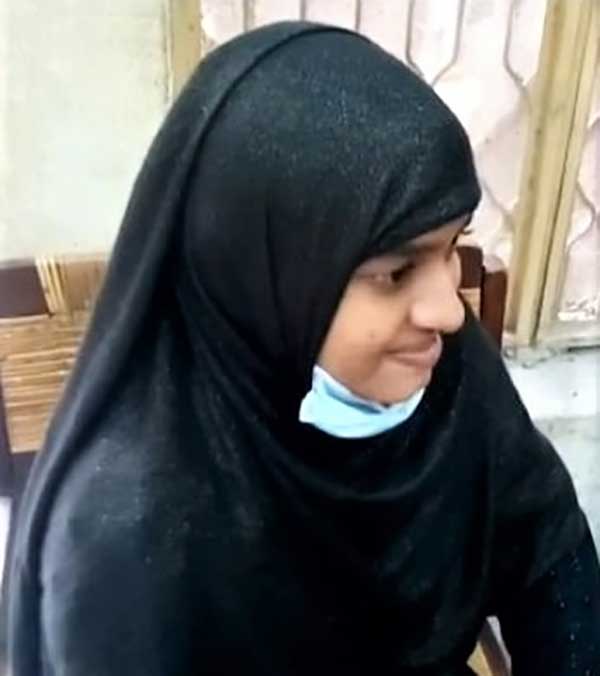
When Gulzar Masih’s 14-year-old daughter did not return home from school in Faisalabad, Pakistan on July 27, the rickshaw driver and his brother set out to find her.

Reaching the school later that afternoon, they found it was locked from the outside. They frantically searched for his daughter, Chashman, on the streets and roads leading to his rented house. They went to the homes of relatives, but she was not there either, he said.

Masih, a Roman Catholic, telephoned police and filed a missing persons complaint that night. He made repeated visits to the Samnaabad police station in Faisalabad on July 28, but officials were slow to act on his case, he said.

“After much pleading, our application was converted into an FIR [First Information Report, No. 622/21], but the police remained indifferent to the issue,” Masih told Morning Star News by phone from Faisalabad.

They persuaded police to retrieve the call data record of a SIM card in a smart phone his daughter was using for study purposes, he said. The SIM was registered in his wife’s name.

“When the police retrieved the call data, it was revealed that Chashman had received a call from an unknown number on the day she had gone missing,” Masih said. “The investigating officer told us that the phone had been turned off and they couldn’t trace its location.”

The next day they received images on the phone of an Islamic conversion letter, Islamic wedding certificate (Nikahnama) and an affidavit apparently signed by Chashman that she had willfully converted to Islam and married a Muslim named Muhammad Usman. The images were received from the same unknown number noted in Chashman’s call records.

The conversion and marriage was registered by a cleric of an Islamist religio-political outfit, the Pakistan Sunni Tehreek, on July 29 in Sahiwal city, the documents show.

“We requested the police to at least recover Chashman and ask her under what circumstances she had left her home, but they are not listening to us,” Masih told Morning Star News. “They say she has changed her faith and married of her own will, so there’s nothing they can do. But my daughter is only 14 – she’s just a child who made a mistake by falling into the trap of a much older man.”

Masih said the family had yet to approach the courts in order to recover his daughter, a sixth-grade student.

“Honestly speaking, none of us are in the right frame of mind since the day our child was taken from us,” he said. “Chashman’s abduction had numbed my mind so much that I mistakenly stated [to police] that she was 17 years old, even though she had turned 14 just three months ago, on May 13.”

Her birth certificate shows she was born on May 13, 2007.

Child marriages are criminal under Pakistan’s Child Marriage Restraint laws. While Pakistani law recognizes intercourse with a girl below 16 years of age with or without her consent as rape punishable by death, courts have repeatedly held that marriage of an underage Muslim girl cannot be termed invalid because Islamic law holds that a consenting girl who has reached puberty can marry, human rights lawyer say.

GROWING LIST OF CASES
Chashman’s abduction adds to the growing list of underage Christian girls who have been forcibly converted and married to their Muslim abductors, particularly in Punjab and Sindh provinces.

On July 1, the Lahore High Court sent Nayab Gill, a 14-year-old Roman Catholic, with her alleged 30-year-old Muslim abductor. Both the trial court and the high court rejected her official birth documents and accepted her verbal claim in court that she’s over 18 years old.

Nayab’s parents have appealed to the Supreme Court of Pakistan with help from the Church of Pakistan for their daughter’s recovery.

The Supreme Court in July rejected an appeal filed by a senior church leader challenging the rejection of his constitutional petition seeking the top court’s intervention in the forcible conversion and underage marriage of Christian girls.

Filed by Church of Pakistan President Azad Marshall, the petition stated that Pakistan accords a degree of permanence to the abduction and forcible conversion of Christian girls by allowing them to marry Muslims without ascertaining the pressures coming to bear on girls when they make declarations of consent before trial and high courts, nor taking into account their intellectual, emotional and social maturity.

It added that such declarations of consent are not investigated to ascertain whether they are voluntary or result from threats, psychological abuse and conditioning and fear of social stigma and rebuke.

A parliamentary panel on minorities earlier this year forwarded key legislation to the government on curbing forced conversions of minority girls, recommending that only adults should be allowed to change religion and only after appearing before a senior district judge.

The government of Prime Minister Imran Khan, however, has strongly opposed the legislation. Federal Minister for Religious Affairs Pir Noorul Haq Qadri has categorically stated that the government is opposed to a restriction on religious conversion before the age of 18 years.

“If someone aged 14 years wishes to convert to some other religion, they could not be stopped,” the minister commented during a meeting of the Senate parliamentary committee on minorities’ rights on July 14, the same day the Supreme Court rejected Bishop Marshall’s appeal.

Qadri added that if someone wished to change their religion before reaching age 18, it was their choice, and that “a Nikah [Islamic marriage] or marriage before 18 was another discussion.”

Pakistan leads the world in forced marriages, with about 1,000 Christians married against their will to Muslims from November 2019 to October 2020, according to Christian support organization Open Doors’ 2021 World Watch List report. In terms of abductions, the report listed Pakistan as fourth with an estimated 100 kidnappings.

The U.S. State Department in December re-designated Pakistan among nine other “Countries of Particular Concern” for severe violations of religious freedom. Previously Pakistan had been added to the list on Nov. 28, 2018.

Pakistan ranked fifth on Christian support organization Open Doors 2021 World Watch list of the 50 countries where it is most difficult to be a Christian.

SOURCE: CHRISTIAN HEADLINES

Evangelist Daniel Kolenda Says Holy Spirit Will ‘Reset the Church, Refocus Us on the Lost’

0

We expect evangelists to focus on the lost. But Daniel Kolenda says in the wake of the COVID-19 pandemic and resultant lockdown, the Holy Spirit wants to reset the church to a similar focus.

“God has a way of taking what the enemy meant for evil and turning it around for good,” the successor to famed evangelist Reinhard Bonnke and head of Christ for all Nations tells Dr. Steve Greene on a recent episode of the Greenelines podcast on the Charisma Podcast Network. “And I believe the Holy Spirit is going to reset the church and refocus us on the lost.

“Instead of having great services within our four walls, we will begin to shake our cities with the power of the gospel, bring heaven to earth and really do what we were called to do all along,” Kolenda says.

Kolenda says Nations Church, wearenations.church, his church plant in Orlando, Florida, is “hours away” from its launch service on Sunday, Aug. 15 at the Hilton in Orlando on Destination Parkway at 10 a.m. He suggests arriving early. But as he shared in a previous Greenelines podcast, the church, even in its pre-launch stage, has already experienced the life-changing power of the gospel.

“It almost feels like it’s already launched, because we’re seeing hundreds and hundreds of people coming out,” Kolenda says. “And we’ve had over 1,000 people saved on the streets of Orlando, people are being baptized in rivers and swimming pools and hot tubs. It’s a movement already, even though we haven’t technically launched. And so I’m just really excited.

Kolenda recognizes that, although Nations Church has seen many move to the Orlando area to be a part of the church plant, not everyone lives in Florida—and not everyone has the gift of evangelism. Yet he also believes God is speaking to churches and pastors in this unusual season.

Kolenda says pastors who may have gifts in areas other than evangelism also have to learn how to grow their churches. “Billboards on the side of the road don’t necessarily do it. It’s getting out on the road in the highways and byways and talking to people who are hurting and need Jesus.”

“I think one of the things that’s got to happen in this in this era, is that the gift of the evangelist needs to be recognized again—and needs to be championed,” he adds. “And if pastors will do that, if they will empower and lift up and celebrate their evangelists, they’ll begin to see the lost saved.”

Kolenda also sees the Nations Church launch as part of something much bigger than himself or CfaN. There’s such a difference between, as evangelist Bonnke used to say, ‘pulling something by the hair’ … and what I just described, this feeling of being carried along by just a torrent of Holy Spirit momentum. … What excited me is God is up to something. I believe the Holy Spirit is doing something in our time that we have not ever seen before. … And every time God does something in the earth, He extends an invitation for His people to get on board. And those who will get on board with it, they can also experience the same kind of miracles and fulfillment in harvest.”

SOURCE: CHARISMA NEWS

Myanmar bishops call for Covid national prayer campaign

0

Prelates appeal for unity and compassion as the country reels from a worsening health crisis.

The Catholic Bishops’ Conference of Myanmar (CBCM) has urged people in the country to join a campaign of prayer to overcome the contagion.

“Through this appeal, I call upon all people to enter into a campaign of prayer, raising our hands and hearts to the Almighty, for healing. Let us come together as one community, let compassion become the common religion in these dark days,” the bishops said in a letter released on Aug. 2.

CBCM president Cardinal Charles Bo and general secretary Bishop John Saw Yaw Han signed the letter.

“Transcending our various religious and faith identities, let us come together for interreligious prayer meetings online. Let us support one another through continuous prayer.”

Faith leaders also urged the Church to hold continuous prayers, adorations and rosary chains in families and communities.

“Let us knock on the divine doors to melt the hearts of all people, to bring healing, peace and reconciliation,” they said.

Once again, we plead, unity is needed. No conflict, no displacement. The only war we need to wage is against the virus

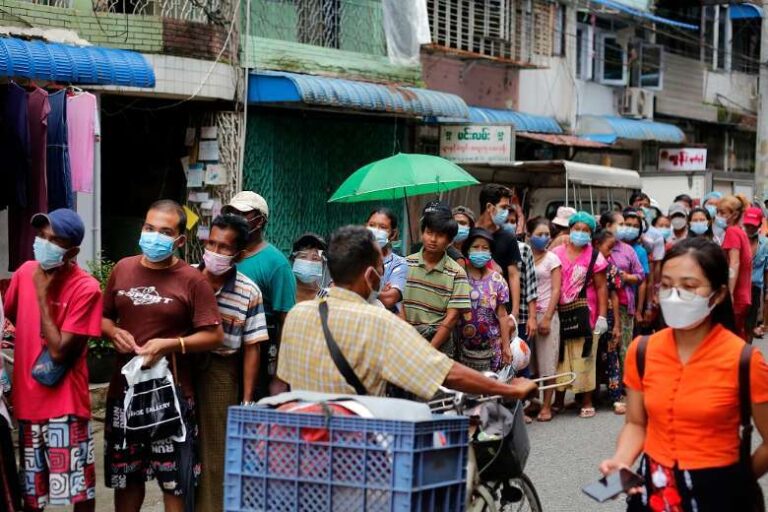
Their appeal comes as the Southeast Asian nation is facing a worsening Covid-19 crisis followed by a political and economic crisis brought about by the military coup on Feb. 1.

Myanmar’s health system has virtually collapsed since the coup. Hospitals are barely functioning and lack staff as many doctors and nurses have joined the mass civil disobedience movement.

The UK warned the UN Security Council last week that half of Myanmar’s population of 54 million could become infected with Covid-19 within the next two weeks.

The junta-controlled Health Ministry recorded 330 deaths and 3,689 new cases on Aug. 3, taking total numbers to 306,354 infections and 10,061 deaths, but medics and charitable groups say the actual number of fatalities is higher.

The bishops lamented the threat to the dignity and survival of people amid rising infections and deaths and the dire lack of oxygen as the Delta variant sweeps Myanmar and other countries.

“Once again, we plead, unity is needed. No conflict, no displacement. The only war we need to wage is against the virus,” the prelates said.

“Facing this emergency, let us arm ourselves only with medical kits, oxygen and other support for our dear people.”

The bishops called for a campaign of prayers starting now and to continue for at least for two weeks.

“Our people’s destiny is more and more in the hands of God as we sail through these stormy seas of fear, despair, anxiety and pandemic. Let the divine hand reach out and bless our country and protect our people from the pandemic and all other calamities,” they said.

SOURCE: UCA NEWS

Nine Years, 782,000 Words Later, South Carolina Woman Completes Handwritten Bible

0

Caroline Campbell’s project aims to inspire Christians to learn Scripture and see disabilities as a gift to the church.

Kenny Campbell was doing some spring cleaning when he found a stack of papers with his daughter Caroline’s handwriting on them. He looked at the pages and realized there was something special about them. It was Scripture, copied word for word by hand.

The Campbells attend Community Bible Church in Beaufort County, South Carolina, and their teenage daughter, who has Down syndrome, was writing down the verses their pastor preached on. Carl Broggi is an expository preacher, going verse by verse; Caroline had recorded those verses in her own hand.

“This is amazing, Caroline, how much you’ve written,” Kenny told her.

On a whim, he said she could do the whole Bible.

“Yeah, okay,” Caroline said.

Those two words kicked off a nine-year project. Starting in January 2012 and finishing in June 2021, Caroline, who is now 28, copied the entire Bible by hand. She started in Genesis and worked her way through Revelation, writing down all 782,815 words from her 1973 New American Standard Bible.

Caroline’s mother, Jennifer, estimates the completed manuscript is more than 10,000 pages. It is compiled in 43 binders.

Once she started, Caroline said, she just didn’t stop. She persisted out of her devotion to the Bible and her desire to encourage others.

“I want to inspire people to learn the Bible,” she told CT.

Kenny and Jennifer say this has been key to their experience of having a daughter with Down syndrome. They have had to learn not to put limits on her. When their daughter was diagnosed, they had deep concerns. But they soon decided to treat her like any other child. And then they learned that she would, on occasion, completely blow them away with the amazing ways she was different.

Bethany McKinney Fox, pastor of Beloved Everybody Church in Los Angeles and author of Disability and the Way of Jesus, said Caroline’s Bible is a good example of the different ways people relate to God.

In many churches today, she said, where most people have the same intellectual and developmental abilities, modes of worship narrow. Having people in the congregation and community with diverse brains and bodies can foster an environment open to a vast diversity of worship.

“It invites you to explore different ways of connecting with God, and I think that that is really helpful,” Fox said. “We’re obviously called to be followers of God with our whole selves. Jesus didn’t say to the fishermen, ‘Here, just read this book and believe these things and you’ll be fine.’ It was ‘Bring your whole life and follow me.’”

Fox’s church, Beloved Everybody, describes itself as “a community of people with and without intellectual, developmental, and other disabilities following Jesus and leading and participating all together.” She encourages all churches to be more open to making people like Caroline full participants of their congregation.

Broggi, the pastor of Community Bible Church, agrees.

“We are so proud of Caroline. She is a great testimony for our church and for the Lord,” he said. “Caroline has been such an inspiration to so many, both in and outside our congregation.”

Caroline serves as a greeter at the church and regularly visits congregants who are in nursing homes. The church held a celebration for her in June, when she finished copying Revelation.

Revelation, as Caroline can tell you from memory, has 22 chapters. As she finished each of the 66 books of the Bible over the years, Caroline would proudly announce the number of chapters in the book. Genesis has 50. Leviticus, 27. The longest and most challenging was Psalms, with 150 chapters, she said. She’s got the number of each memorized.

“My favorite book is Esther,” she said.

Even as the project stretched on—in chapters and years—Caroline never considered quitting. She spent about two hours a day transcribing and continued regardless of where she was on a given day. Sometimes she was at home. Sometimes she was with her parents at a golf course. Day after day, she devoured the words.

“It was amazing to watch her do it,” Kenny said. “It was never boring to hear her say where she was at or what she was doing. It didn’t take encouragement to keep her going.”

Inspired by her devotion to the Scripture, there were times Kenny would try to read through the book of the Bible that Caroline was working on. More often than not, she beat him through it.

Over the years, the Campbells have marveled to see Caroline excel in life. They credit Jennifer’s late mother, Norma, as a huge help to them in the early days. She was a retired teacher and devoted hours to Caroline, teaching her to play the piano, ride a bike, and write.

“She was so instrumental in so many things that Caroline does today,” Kenny said. “It’s a constant reminder of her discipline that she put into Caroline in such a loving way.”

Jennifer said when she sees her daughter, she’s regularly reminded of the fruits of the Spirit. Caroline can tell when people are hurting, and when she knows that someone has lost a loved one, she takes the time to handwrite Psalm 23 and gives it to the person.

A few years ago, she got a job at Zaxby’s, the chicken sandwich chain, and Caroline has been recognized there for her joy.

Hollis Murray, owner of the local franchise, has said he knew Caroline was special in their first meeting, when Caroline came in for a job interview.

“I came out of that meeting saying, ‘This girl is a star,’” Murray said in a video posted to recognize Caroline. “Her personality shines. She’s a true star, and her star radiates. Her attitude makes ours better.”

As happy as the Campbells are to see Caroline succeed at her job or be a great volunteer at church, they’re happiest to see how she embraces her faith. Kenny and Jennifer said they did their best to take a normal approach to teaching Caroline about God and salvation.

“The gospel is pretty straightforward and simple to understand—the death, burial, and resurrection. She came to know that truth,” Kenny said.

“That’s it,” Caroline chimes in.

Since her handwritten Bible has received some attention in the media, Caroline is happy to hear she’s inspired others to love the Scripture as she does. She recently received a letter from a seminary student on the West Coast who told her he is going to start writing out the Bible by hand too.

Kenny and Jennifer also hope it will encourage families and churches to be more open to people with disabilities.

“So many times, people focus on the negative and not the positive,” Kenny said. “They don’t realize God has given them a gift.”

SOURCE: CHRISTIAN TODAY

‘They Cannot Burn Jesus Out of Me’: Mozambique Pastors Minister to Survivors of Violent Insurgency

0

Despite the risks in the region, Christians are flocking to camps and targeted villages to provide resources and spiritual care.

Back in April, when armed men began attacking his village in the middle of the night, a pastor of a local church in northern Mozambique woke his family to flee. He took his two older sons and his wife took their two younger sons. In the midst of chaos and confusion, shouting and shooting, they escaped in two different directions.

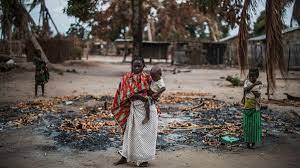
The pastor and his sons hid in the surrounding bush all night before returning to the village, near the town of Palma, to look for the rest of their family. The next morning, he found their hut caved in and the remains of his four-year-old son, who had been beheaded by the attackers. All he and his sons could do was dig a hole in the ground to bury the young boy’s body and weep together. To this day, his wife and second-youngest son are still missing.

This pastor shared his story with CT through English-speaking ministry partners in Mozambique. He asked that he and his village remain unnamed for security reasons, but his story is not unique as conflict escalates in the northern province of Cabo Delgado.

Countless innocent civilians are fleeing the area where insurgents have been burning entire villages to the ground and brutalizing their inhabitants—including beheading, recruiting, capturing, enslaving, and committing sexual crimes against them. The violence has killed thousands of people and displaced upward of 800,000, a number that is growing rapidly and may soon reach one million, United Nations officials warn.

“The north of Mozambique, especially Cabo Delgado province … is being affected by Islamic insurgents, who at some stage claim to be linked with Islamic State,” said Mauricio Magunhe, faith and development coordinator for World Vision Mozambique.

“For the Christians living in that area, it’s very important to have the word of God so that it can renew their faith and hope in such a time of turbulence. The word of God can be used in efforts for peacebuilding in that area, as well as in the country as a whole,” he said. “If we work together as Mozambican citizens and as leaders from different religions, it is possible to educate our people not to adapt that kind of situations that bring a lot of destruction and pain for our people.”

The atrocities of the past four years hearken to the ’80s and ’90s, a tumultuous period in which a series of sociopolitical conflicts shook the African continent, including the Rwandan genocide and Mozambique’s own 16-year civil war from 1977 to 1992. Over the last two and a half decades, however, Mozambique enjoyed relative peace and stability apart from suffering natural disasters in recent years, such as Cyclone Idai in 2019.

Christians make up more than half the population in the country as a whole but are less prevalent in the northern provinces where the insurgency has gained a foothold. Instead of leaving the area and prioritizing their own safety, many local pastors and national believers are staying in the province to serve among their fellow survivors.

In nearby villages and makeshift camps set up throughout the region, these faith leaders are partnering with a handful of ministries, missionaries, and Christian humanitarian organizations to distribute food, supplies, and farming kits, as well as pray with people, preach the gospel, and hand out thousands of solar-powered audio Bibles to all who ask. And in the midst of an unthinkable crisis, they report that thousands are coming to faith in Christ.

“When we first arrived, our arms were crossed—we were sad and angry,” said another pastor whose family is still missing. He also asked that CT not print his name out of fear of further attacks. “But because we serve, we’re strong. Because we serve, we’re happy. In a time of difficulty or in a time of ease, we will serve the Lord.”

From within these camps, pastor after pastor shared their testimonies. One quoted Psalm 23, saying as he and his family walked past dead bodies on either side of them, they found comfort in the line, “Even though I walked through the valley of the shadow of death, I will fear no evil” (ESV). Yet another pastor, who has lost everything, said, “They can burn our houses, they can burn our food—but they cannot burn Jesus out of me.”

Antonio Matimbe, a native of the country who has worked for World Vision Mozambique for over ten years, recently visited a camp for people displaced by the violence. He said that at first he thought everyone seemed to be were doing fine. “But when I started to hear the stories, that’s when I had a real sense of the dimension of the disaster and the situation that people have been through in Cabo Delgado,” he told CT. “It was kind of eye-opening to the real things they have been through, especially when we talk about the children—they have witnessed things that they should not witness as children.”

Matimbe, who manages communications at World Vision Mozambique’s national office, still has vivid memories from the civil war when he lived in a rural village with his grandmother. As a child, he was awakened in the middle of the night, alerted to the approach of military men nearby—and recalls running in the dark to hide and sleep in the bush until morning.

But all of this is nothing, he says, to what the children in Cabo Delgado are facing. Kids as young as four will forever carry the memories of family members, neighbors, and friends killed in front of them, or of the physical or sexual violence they have experienced.

A particular emphasis in World Vision’s effort is to provide counseling in the camps, since the majority of survivors have endured unimaginable trauma. The organization is partnering with the religious council of Mozambique and working with local officials to train and equip camp workers to recognize and respond to trauma-related symptoms.

In these cases, Matimbe says, “Psychological support is as important as providing them with food and water, because these traumas—if they are not well managed, if the children cannot recover from that—we don’t know what kind of adults you can expect.”

Mozambique recently jumped to 45 on the World Watch List of nations with persecuted Christians—after at least 300 believers have been killed for their faith and 100 attacks on local churches, ministry bases and other Christian establishments such as medical missions clinics. These statistics were validated in the latest reporting period and gathered directly by survey teams from multiple sources on the ground.

“This isn’t one or two different attacks—this is a series of attacks, and it’s all around. ISIS is trying to get a foothold in this northern region of Mozambique,” says David Curry of Open Doors USA. “It;s complicated, of course, by all of the different political stuff… but the gist of it is that Christians are really in the danger zone because the Islamic State group there has an ideology which justifies these attacks.”

The insurgency in Mozambique is targeting not only believers but countless innocent civilians of all ages and religions. Despite the population being divided between Muslims and Christians, the country has enjoyed a long history of religious harmony due to the uniquely influential role of its faith leaders in society.

World Vision, an evangelical humanitarian organization that has established a strong presence in Mozambique since 1983, began facilitating interfaith gatherings a year ago to pray for peace and political stability. The latest event was held in person last month at Peace Square in the capital city of Maputo—a couple miles away from World Vision’s national headquarters—and was recorded live and broadcast online.

Among the high-profile figures in attendance at the event were the former president of Mozambique, Joaquim Alberto Chissano, and retired Anglican bishop Dinis Sengulane.

The latter is a well-known national faith figure who made first contact with the Renamo rebel group back in 1989—an act that began peace negotiations and eventually led to the official treaty signed by both parties in 1992, thus ending communism, declaring religious freedom for all, and initiating twenty-some years of peace in the nation. These same leaders also played a role in stemming the return of targeted armed conflict in 2013 by the opposition party, Renamo toward the current party, Frelimo.

Today, the Christian Council of Mozambique—which includes Orthodox, Catholic and Protestant leaders—are once again banding together on a national level to lead the country in a renewed fight for peace and political stability. Beyond holding prayer events throughout the region, many are also serving on the front lines of the conflict to minister among those fleeing and forcibly displaced.

These Christian leaders are partnering with other religious and government officials to set up “peace clubs” in the northern regions to “counter potential radicalisation of youth and promote dialogue and alternative pathways to protest,” according to Alex Vines, who heads up the Africa program at the London-based think tank Chatham House.

“What is unique about the interfaith relationships in Mozambique is we understand that in order for us together to grow as a nation, we need to collaborate with one another,” said World Relief’s Magunhe, who is also an ordained member of the Anglican clergy and the key facilitator behind these national prayer meetings.

“In some regions, like in the north, half of the population are Muslims. If that conflict grows, then that will become a very serious issue for our people… So I believe church leaders have an important role to play in the current situation.”

However, experts warn that such efforts may be putting these religious leaders and faith groups in danger. Recent intelligence reports point to a growing security threat for high-profile figures engaged in faith-based ministries and nonprofits as well as foreigners and expats. And there are fears of a rising threat for hostage and ransom situations.

Last September, when two nuns were captured by the extremists, Catholic bishop Luis Fernando Lisboa of the diocese in Pemba, the city center nearest to the conflict, successfully negotiated their release. After Bishop Lisboa became more outspoken about the conflict in the following months, he was suddenly reassigned to Brazil in February—likely for security reasons—after serving in the Pemba region for almost 20 years.

“The risk is escalating. It’s not getting better for NGOs—and the insurgents know it,” said Jasmine Opperman, a private risk analyst who is based in neighboring South Africa and specializes in terrorism in the continent.

The fledgling insurgency launched its first attack on three police stations back in October 2017, and “in the first year, it looked like something small that could be crushed by the government,” said Angelo Pontes, a veteran leader in disaster response for World Vision Mozambique, as well as a native Mozambican. “But that wasn’t the case—because three years on, things have escalated and are probably very far from ending.”

The group appears to be well-funded, with more advanced training and weaponry, and its attack tactics seem to be increasing in both their strategy and sophistication. Their method of killing is primarily by beheading, and there are rumors of far worse forms of mutilation being used.

The groups often announce their presence by calling out the battle cry of Islamic extremism, “Allahu Akbar,” and there are reports of Muslims killed because they could not recite the Quran in Arabic. Starting in 2019, the global Islamic State announced its involvement in the insurrection in their propaganda, explicitly claiming credit for the attack in Palma, which attracted worldwide notice.

According to Vines, however, it is a misconception to say a firm connection exists between the two. In fact, he says it “was a surprise to many international observers, especially those in the diplomatic community,” when the US State Department designated ISIS-Mozambique a Foreign Terrorist Organization back in March.

Because while there is indeed a “small hard core of radicalized individuals, some of them foreign fighters (mostly from Tanzania)” leading the charge, Vines says most regional experts and analysts would agree that “the conflict in Cabo Delgado remains more a rejection of mainstream elite politics than a deeply radicalized religious one.”

Though a number of “churches and missions have also been targeted,” Vines says, the insurgency’s primary focus is on attacking “organs and facilities of the state,” since their chief grievances lie with Frelimo, the political party of the incumbent government. He says that “a core driver was a purist Muslim cult that regarded mainstream Islam as compromised” due to its connections with the government and its affiliation with outsiders and interreligious relationships—especially with Christians, who they call “Crusaders.”

“The anti-government sentiment is linked to religious extremism in Cabo Delgado—they do cross to a certain extent,” says Opperman. But as to the insurgency’s ultimate goal or plans, there is much speculation and very little that is known for certain.

Mozambique, which lies on the southeastern coast of Africa, between Tanzania and South Africa, is currently the eighth poorest country in the continent. The nation’s highest poverty rates are in the rural northern provinces—where the population has yet to reap any economic benefit from the natural resources being mined in their region, which are funnelling instead towards a wealthy elite in government and corporations.

Thus, apart from deploying targeted military strategy to weaken the insurgency’s core, Vines maintains that the violence can be curbed in other ways. He believes that the majority of the uprising’s local supporters, some of whom have been offered a daily sum to join the insurgency and their campaigns, “would peel away if there were alternatives offered”—which, in the long run, would include sustainable solutions for economic development to improve the overall livelihood of the region’s population.

The official name of Mozambique’s insurgency is Ansar al-Sunna, but it’s known locally as al-Shabab, meaning “the youth,” which is their most targeted demographic. In many villages, boys as young as 10 are made to enlist as child soldiers and girls as young as 12 are forced into marriage as child brides—and anyone who does not comply is killed. There are also reports of sexual assault incidents involving women as old as 60.

These bands of militants often arrive in the middle of the night, causing heightened panic in the darkness, and then issue a warning to those they spare that they will come back and kill anyone who tries to return to the village. Those who manage to escape will hide in the outlying bush until daylight, with only the clothes on their backs, until they begin their perilous journey.

Often walking for days with no food or water, survivors will first make their way to the homes of their extended families who live in Pemba and nearby villages. From there, a number of them will make their way to makeshift camps that have been set up throughout the province. Only then do some of them make it to camps for internally displaced people (IDP) that which are officially run by the United Nations High Commissioner for Refugees (UNHCR).

Unlike its contemporary equivalents in other parts of Africa—such as al-Shabaab in Somalia, Boko Haram in Nigeria, or the Allied Democratic Forces (ADF) in the eastern Democratic Republic of the Congo—the Ansar al-Sunna insurgency in Mozambique has garnered little media attention since it began.

“Not many people out there know what’s happening in Mozambique,” says Pontes, who has worked in crisis response for years. “On a daily basis, we see the news about issues in some corners of the world, and from time to time I keep asking, ‘Why aren’t they also bringing stories about Mozambique?’ The issue in Cabo Delgado is a serious one—why aren’t they doing something?”

Many Mozambicans do not have access to reliable reporting, and often the news outlets outside the country include more accurate information and updates than those within.

“Internally, the pro-government news outlets do not actually share much about what’s happening in Cabo Delgado,” Pontes says. “Most of us actually end up learning a lot about what’s happening there through other news media groups,” as well as through social media posts and updates from analysts and regional experts.

After more than 15 years of field work, Pontes leads the Humanitarian and Emergency Affairs team at World Vision, which is partnering with UNICEF and a handful of other Christian humanitarian organizations to implement basic necessities in local villages and IDP camps—such as clean water, waste management, and safe sanitation. As new families are being resettled by the thousands every day, the number of public-health concerns are further compounded by COVID-19, which continues to ravage the country.

Pontes was on site back in November 2020 when one of the first official camps opened in the neighboring Nampula province. As of May, the Corrane camp has become home to nearly 65,000 people—around 85 percent of whom are women and children, according to World Vision. And although the needs of survivors seeking refuge in the camps have increased exponentially, donor support for World Vision and other nonprofit organizations has steadily decreased.

“Since 2020, it’s been challenging,” Pontes says. “But we keep trying and knocking on the doors.” Their current goal is to raise $5 million to meet the rising demands.

Pontes lived in the city as a child, but he can still remember praying for God to protect his parents when they left home to work in the rural provinces for days at a time. Now 46 and with two young children of his own, Pontes wishes they wouldn’t have to go through the same experience.

“It’s terrible that kids today need to hear about this. And sometimes it’s something so bad happening that everyone is talking about it—and even if you want to protect them, they end up hearing about these things,” he says.

“But my kids are small,” Pontes said, “and I just hope and pray that this will end one day, and they won’t have to hear about it—or they will end up hearing something written in books or the sort, not in news that they have to deal with on a day-to-day basis.”

Another major Christian NGO in northern Mozambique, whose name is withheld for security reasons, has been working closest to the conflict. They are caring for and ministering to the hundreds of thousands of men, women, and children who have yet to reach the safety of camps. Most of them are lodging in Pemba and surrounding villages, often with extended family and friends and many are hosted in homes of believers.

This organization is facilitating widespread, prayer-led trauma counseling—a ministry conducted by national believers who are fluent in four of the region’s primary dialects. And in the past few months, the organization reports that thousands of people are not only coming to faith in Christ but also receiving deep spiritual and emotional healing.

“It is a tremendous privilege to be partnering in Mozambique for such a time as this,” said one of the organization’s founders, whose name is also withheld. “The body of Christ in northern Mozambique is not discouraged. No matter how dark things get, we’re called to shine in the midst of it.

“Love wins, and it always triumphs over hate,” the leader said. “And everybody—absolutely everybody—is saying yes to Jesus.”

SOURCE: CHRISTIAN TODAY

Ontario Church Fined an Additional $85,000 for Violating Lockdown — ‘Jesus Is Worth It’

0

On Tuesday, a Canadian church was ordered to pay over $80,000 in fines after the church was held in contempt of court for a second time.

Trinity Bible Chapel, a Waterloo-based church, was sentenced for holding a worship service in April in violation of provincial COVID-19 restrictions on in-person gatherings, The Christian Post Reports. In May, a Canadian judge ordered officials to lock down the church, which has since held its services outdoors.

The order, which was issued by Justice John Krakchenko, calls on the church and its leaders to pay a total of $85,000 in fines. According to Kitchener Today, the church was given a $35,000 fine, pastors Jacob Reaume and Will Schuurman were fined $10,000 each, and four church leaders were each fined $7,500.

The recent fines come months after the church was fined $83,000 for holding a service on January 24 along with $45,000 in legal fees. At the time, the church violated restrictions imposed by the Reopening Ontario Act, which limited in-person indoor or outdoor services to 10 people.

In a blog post on Tuesday, Reaume noted that an appeal for the contempt charge is unlikely, meaning the church will likely have to pay the fines.

“Keep in mind that we owed $45,000 just for legal fees for the January 24 conviction. For contempt proceedings, it’s unlikely that we can appeal,” Reaume explained. “So we’ll have to pay up. When this is all added up, we’re gonna owe a lot of money. But Jesus is worth it.”

The pastor also shared that the opportunity to regain entry into the church building was given but with the prerequisite that COVID restrictions must be followed.

Reaume, however, refused to abide by the protocols.

“In fact, while in court last week, we said through our counsel, “The church is the Bride of Christ and we cannot hand her over to Premier Ford — no undertaking on that basis will be given.”  That was recorded in the court file,” he said.  

Following Tuesday’s court hearing, Reaume pointed out that the judge” did not require an undertaking to regain entry to our building.”

“So there’s a chance we could be in soon. But there’s some things we need to iron out. Stay tuned for more details,” he concluded.

Trinity Bible Chapel created a GoFundme page in helping the elders pay off the fines. At the time of this writing, the church has raised $73,710 out of its $150,000 goal.

On Thursday, the Ontario government stated that the province has moved up to Step 3 of its reopening plan titled, “Roadmap to Reopen.”

According to Step 3, at least 70 percent of the adult population has received one dose of the COVID-19 vaccine while at least 25 percent has been fully vaccinated.

The updated guidelines now permit indoor social gatherings and organized public events for up to 25 people, and indoor religious services are permitted with physical distancing. Meanwhile, up to 100 people can meet for outdoor gatherings and events.

SOURCE: CHRISTIAN HEADLINES

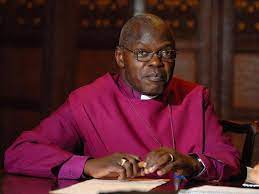
John Sentamu to succeed Rowan Williams as Chair of Christian Aid

0

The former Archbishop of York will be the next Chair of the international development agency Christian Aid.

Rt Revd & Rt Hon Dr John Sentamu, who was the Archbishop of York from 2005-2020 has spoken about poverty and justice for many years. 

Born in Kampala, Uganda, Dr Sentamu will be the first person of African descent to take up the position of Chair in Christian Aid’s 75-year history.
 
Dr Rowan Williams, former Archbishop of Canterbury and the current Chair, will stand down in November. 
 
Christian Aid’s CEO Amanda Khozi Mukwashi said it was wonderful news for Christian Aid: “Dr Sentamu brings with him a passion and energy for global justice, a deep love of the Church and a profound theological understanding that will be able to speak into the crises of climate change, Covid, conflict and debt that are affecting the world’s poorest communities. We look forward to welcoming him to the Christian Aid family.

“I want to express my immense gratitude to Dr Williams for his friendship and leadership. He has been an incredible Chair, bringing his inimitable wisdom, grace and prophetic voice to support Christian Aid’s work and the communities we serve. We will miss him.”

Commenting on the appointment, Dr Rowan Williams said: “I am delighted to be handing over the reins to Dr Sentamu at this pivotal time in the organisation’s history and convinced there are few people who will be able to lead and speak out with the moral voice that is needed for such a time as this. I will continue to support both him and the organisation in the ongoing fight to end global poverty.”
 
Dr John Sentamu, who is also a member of the House of Lords, said his appointment was “a great surprise and a delight.”

“My first involvement with Christian Aid was in 1980, during Christian Aid Week, when, as an Assistant Curate at St Andrew, Ham Common, and Prison Chaplain at Latchmere House Remand Centre, I knocked on doors and left Christian Aid envelopes. The staggering response from the long street where I lived, as well as the prison officers, convinced me that the appeal for ‘Life Before Death’ spoke to the generous hearts of my neighbours.
 
“In 2004 I visited Herat Province, in Western Afghanistan, to see and encourage Christian Aid workers there. They blew my mind and I rejoiced greatly to discover that they had favour with all the people; and that Christian Aid workers had remained there for well over 25 years!
 
“To chair the Christian Aid Board, which is deeply committed to eradicating injustice, disadvantage, increasing mutual accountability and its prophetic voice in addressing issues of poverty and power, is a great honour and challenge for me. Please pray for me.”
 
Dr Sentamu will formally be welcomed by Christian Aid’s church representatives in November 2021.

SOURCE: PREMIER CHRISTIAN NEWS