Home Blog Page 140

Induction Of The Bishop And The Diocesan Lay Chairman Of The Sefwi Bekwai Diocese Of The Methodist Church

0

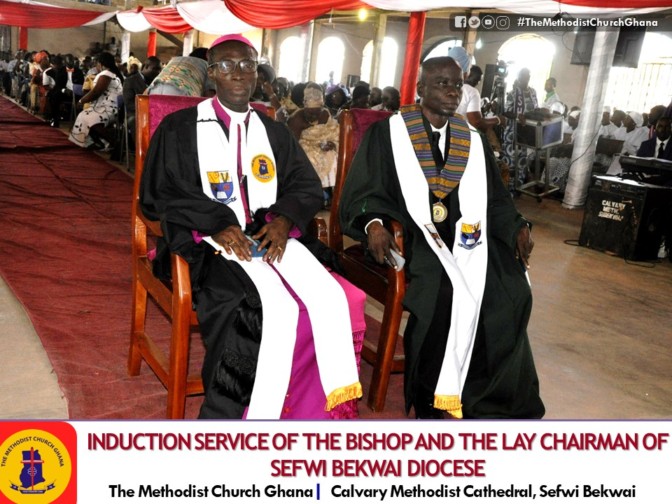
The Sefwi Bekwai Diocese of The Methodist Church Ghana inducted a new Bishop and Diocesan Lay Chairman for the Diocese. The Diocese is made up of 31, 788 members representing 3.84% of the entire Connexional Membership Community for the 2017 statistical returns. Both the Bishop and the Lay Chairman were elected by the Diocese during their 2018 Annual Synod.

The induction Service brought over 2,600 people from the Connexion to grace the event. The Induction was held at the Calvary Methodist Cathedral – Sefwi Bekwai. The service was officiated by the Executive of The Methodist Church Ghana led by The Presiding Bishop, The Most Rev. Dr. Paul Kwabena Boafo, The Lay President, Bro. Bernard Clement Kwesi Botwe and The Administrative Bishop, The Rt. Rev. Michael Agyakwa Bossman.

Diocesan Lay Chairmen, past Lay Presidents and Bishops were all around to support them. Family and friends were not left out.

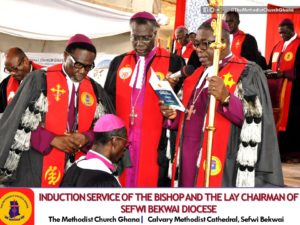
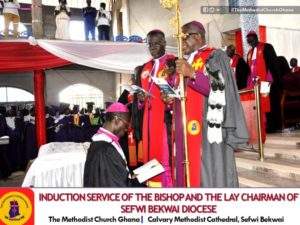
Robing with Vestments and Insignia of office: The Bishop was robed in a very beautiful gown with the stole of office designed with the Diocesan logo. The robing followed the Episcopal process of recognition symbolic with vestments that shows authority, Connexionalism and unity in the Body of Christ. Before the Bishop was robbed, The Lay President of The Methodist Church Ghana, Bro. Bernard Clement Kwesi Botwe presented him to the Presiding Bishop for his induction having read the constitutional mandate given by the Synod of the Diocese and endorsed by Conference. The following were presented to the Bishop.

The Skull Cap indicates that the head that was once crowned with thorns is now crowned with glory of leadership. The Pectoral Cross indicates his sharing in the authority of the Methodist Church Ghana. The Connexional Bible is the token of authority from God to teach and transform the people under his authority. The Ring signifies his fidelity to the Church in Christ. The Constitution of the Methodist Church Ghana was also presented to him as a guide to enforce the doctrines of the Methodist Church Ghana. These vestments are symbolic of his office and seeks to remind him of his responsibility to the people “Called Methodists” called by grace and saved through Christ.

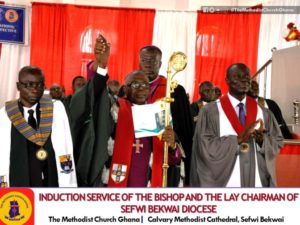
The Lay chairman was also inducted into office in a very beautiful solemn manner. He was robed with a gown and badge of office by the Lay President, Bro. Bernard Clement Kwesi Botwe. It was all joy as Bro. Alex Manu Adubofour responded to his charge with a promise of commitment to serve the people of Sefwi Bekwai.

The Sermon: The Presiding Bishop, The Most Rev’d. Dr. Paul Kwabena Boafo gave a very thought-provoking sermon that reflected on “Adding up to our numbers”. He cited the Apostles in Acts 2 as people who worked very hard to win souls for God. He charged the Bishop and the Lay Chairman to teach like the Apostles with focus on true word of God, praying for the weak and even our enemies, breaking of bread and fellowship as a family in love. He again charged them to serve in humility and in love.  Long Live! The Methodist Church Ghana, Long Live! Sefwi Bekwai Diocese.


Story by: Alexander Nii Odartey Lamptey (Content Manager-CPD)

Why Is Evangelism So Hard?

0

My life mission statement is short and easy to remember: To reach the lost and teach the found to reach the lost. Over the past three decades I have led outreach training for leaders from Los Angeles to La Libertad, El Salvador. I have spoken about evangelism to groups from Tauranga, New Zealand to Amsterdam.

This is my calling and passion. It is what I try to do with most of my days and hours, but I have to admit that doing evangelism is still difficult. If I don’t fan the flame and stay attentive to outreach, my heart can grow cold and my evangelistic activity will wane.

We all believe in the Great Commission and most of us are committed to follow this call of Jesus, but it is just plain hard. Momentum gets stalled. Attention gets distracted. We drift off course. The next thing we know, our lives and churches are doing lots for believers and our focus on the lost fades. After encountering thousands of pastors, elders, staff members and church leaders from around the globe, I have seen the same three obstacles to evangelism surface over and over again.

SPIRITUAL WARFARE

All the forces of hell are set against the person who seeks to reach out with the good news of Jesus. When a church mobilizes to equip believers to share their faith, it is a declaration of war. Honestly, I don’t think the demons of hell tremble when we meet for a church potluck. But when believers are prepared, passionate and engaged in evangelism, the demons arm for battle.

Because of this spiritual reality, many churches stop reaching out and engaging in intentional evangelism. In many cases they don’t even know why. They don’t recognize they are facing demonic lies, satanic attacks and hellish battles. Our Enemy will seek to destroy us, our family and our church, and will pull no punches. If we do not recognize and identify his tactics, we will find ourselves quickly sidelined and discouraged. We will spend our time doing the easy things, but not what is most important.

Instead we must fight the good fight. We must arm ourselves with the Word of God and immerse ourselves in the truth of the Scripture. To do this, we need to open the Bible daily and teach others to do the same. When Jesus faced the Enemy in the wilderness, he quoted the Bible in the face of each temptation. Like Jesus, we need to know the truth of Scripture, believe in the power of God’s Word and have it so deep in our soul that we can declare the message of the Bible confidently and consistently.

We also need to pray in power against the tactics and activity of the Enemy. In the name of Jesus, because of the victory of the cross and the resurrection, we can resist the Devil and watch him flee. We must live each moment profoundly aware that God, who is in us by his Holy Spirit, is greater than our Enemy who is in this world.

If we are going to share the love, grace and message of Jesus (and call others in the church to do the same), prayer will be a weapon we must wield every day. I would also suggest you develop a prayer team around you and your church. If you are going to stand strong and enter the spiritual battle, you will need a consistent team of prayer warriors at your side. Give them fresh prayer needs on a regular basis and keep them praying.

FEAR

Most followers of Jesus are deeply fearful of engaging in sharing their faith. We can even be timid about walking with people toward the Savior, having spiritual conversations and telling stories about our own relationship with Jesus. I have met countless pastors who have confided that they make no time in their schedule to be with nonbelievers and they don’t offer invitations to accept Jesus from the pulpit because they are afraid no one will respond and they will look silly.

Many Bible-believing Christians are afraid to engage in spiritual conversations because they fear rejection or being asked a question they can’t answer. More and more, followers of Jesus are nervous to say they love and follow the Savior because of the dishonest caricature of Christians that is often portrayed in the media.

Admit your fear, name it and stand in faith. A pastor will pull me aside after an Organic Outreach Intensive or training event and admit their secret fear of sharing their faith. They confess their personal sorrow about never (or rarely) giving an invitation for people to respond to the gospel. Once they have admitted this fear, many of them say, “I am going to change. I will lead my church in a new way. I am ready to learn how to lead an evangelistic movement in my church and live it in my life.” The truth is powerful and the Holy Spirit is ready to lead us outward with the truth of the gospel.

When Christians declare their desire to engage in the evangelistic mission of Jesus and name their personal fears, something changes. As each fear comes into the light of Jesus, it melts, shrinks and pales in comparison to the power and glory of our Savior. Faith can flood in. We can strategize ways to confront our fear with action.

As we engage in outreach, we feel the Holy Spirit’s power fill us, we sense Jesus with us and we see evangelistic fruit. Even when an evangelistic encounter or conversation is hard, it is always worth it. Our faith grows as we are faithful to the call of Jesus.

LACK OF TRAINING

Every Christian should be prepared to explain the hope they have because of faith in Jesus. We are expected to do this in a respectful and gentle manner, but the problem is most Christians have no idea how to articulate their faith. We don’t know how to engage naturally in conversations about spiritual issues. We have not thought through how we can tell our story of faith or the story of Jesus in a way that is organic and compelling. Unfortunately, too many pastors have never trained their congregation in the basics of organic outreach. So, people simply do not do it.

Get equipped for the work of outreach. It is easier to stay uninformed and unengaged when it comes to evangelism. But, we must refuse this enticement. Commit to be prepared for daily outreach encounters and engagements. Read a practical and down-to-earth book about how to share faith naturally. I would suggest Organic Outreach for Ordinary People. If you are a preacher, commit to doing a three-week preaching series every year through which you equip your congregation to share faith naturally.

Practice sharing your testimony of how you became a follower of Jesus. Do this with other Christians to get warmed up, then share your story with people you know who are not yet followers of Jesus. Practice sharing the story of Jesus’ coming, love, life, sacrificial death and resurrection. Go over it until the words are natural and the message is embedded in your heart. Then share it with someone who needs to know about God’s great love.

Get prepared, because God is ready to send someone your way who is open, hungry and longing for more in life. You have what they need—or better yet, whom they need. Don’t let the tactics of the Enemy, fear or lack of preparation get in the way. You have met the one who is the way, the truth, and the life—share him freely.


By Kevin Harney

Kevin Harney is the lead pastor of Shoreline Church in Monterey, California, the founder and visionary leader of Organic Outreach Ministries International, and the author of the Organic Outreach series and many other books, studies and articles. For more information: KevinGHarney.com

The 4 Key Words of Outreach Strategy: It Starts With Me

0

For over five years, the Billy Graham Center has been gathering senior pastors into cohorts that meet monthly to receive encouragement and accountability in their personal witness, and to be equipped to lead their churches in evangelism. Brian Davies, lead pastor at Lord of Glory Lutheran Church in Grayslake, Illinois, is one of about 60 pastors currently in an evangelism cohort.

As pastors, we often don’t know where to begin when it comes to outreach. We know that outreach is a biblical concept, and we know that it was important to Jesus and ought to be important to us. But we are torn about how to start. Should it be a program? Should a committee take it on? Should we launch a message series or perhaps invite an outside speaker to come in and rally the troops?

I know what this uncertainty is like because I’ve been there before—unsettled, confused and feeling a bit guilty. Maybe you’ve been there too. Perhaps you’re there right now. Thankfully, the Lord brought some wise people into my life and led me to an essential shift in thinking centered around four key words.

It starts with me.

This small phrase has huge implications. It means that before I think about mobilizing our whole church around living with an outreach mindset, I need to first live with an outreach mindset. That was a hard change for me. Just like with eating healthy, working out or being honest all the time, it was a whole lot easier for me to tell others what to do rather than challenging myself to live it out. Yet if I truly wanted to lead this evangelism charge, I knew that I first had to live this charge.

Precisely because this mental shift is so powerful and transformative, the Evil One doesn’t want you to start with you. He’d actually prefer you remain a “professional Christian” hunkered down in your office, planning out ways to tell other people what they ought to do. In fact, what if one of Satan’s greatest secret strategies is to take people who love the Lord, remove them from daily life and pull them into the vortex of church leadership? I’m convinced that he likes it that way and wants to keep the status quo because it separates us from the greater kingdom impact we could be having in the lives of those disconnected from God.

Yet our God is greater, and those four key words—it starts with me—remind us where to begin. They show us how, by the power of the Holy Spirit, we might both destroy the work of the Evil One and invite more and more people into a living relationship with Jesus.

So what did this mindset shift actually look like in real life? It started with my recognizing where the Lord had uniquely placed me. As I considered the various contexts of my life, I developed a richer understanding of how all of my experiences could be informed by an outreach mindset. I began believing that people in my life were sent for a reason, and that I shouldn’t ignore the significance of those interactions. I resolved to take initiative to engage people in spiritual conversations instead of waiting for a church program, message series or special event to reach out to them.

More practically, it meant scrolling through my phone less while waiting to pick up my kids and socializing face-to-face instead. It meant actually getting to know my neighbors beyond a quick wave before heading inside. It meant engaging with the work of our greater community and getting to know the people behind the faces and titles. And it meant seeing everyday conversations as perhaps something God might actually have ordained.

The best part of this process has been seeing how those four words bled into the broader culture of our congregation. As we started sharing stories of personal outreach, individuals in our church began to take greater personal ownership for the vision for outreach. In the Lord’s timing, living with an outreach mindset is becoming a core family value in our church community.

The transformation in our church has not come from a program, a sermon or a speaker. Instead, the transformation resulted from a mindset shift, and it starts with me.

To learn more about Billy Graham Center pastor cohorts, visit Wheaton.edu/BGC.

By Brian Davies

The Overlooked Evangelists in Your Church

0

I’m a big believer that a church’s paid staff sets the tone for the church’s initiatives. So if you change the evangelism temperature of the staff, you can change the evangelism temperature of the church.

Why? We’ve done over 1,200 searches, and I don’t think we have ever been asked to do a search for an “evangelism pastor.” It’s just not a job type churches are using much anymore, which is part of a larger trend of churches hiring fewer and fewer specialized staff members.

I think the key to increasing evangelism at your church isn’t hiring someone to oversee evangelism. Instead, it is hiring people who have a natural ability to welcome newcomers. View evangelism through this lens, and you open up a much wider field of possibilities.

Consider the following outside-the-box people as staff members (or volunteers if you don’t have a staff) to help increase evangelism at your church.

1. Salespeople

Nobody wants to admit it, but let’s face it, evangelism is sales. The right type of salesperson can be perfect for increasing evangelism in your church. I’d stay away from people in transactional sales, which usually includes the pitch “But wait, there’s more!”

Instead, look for people in consultative sales. This type of sales requires a trusted advisor, usually for a larger purchase. Think of a good realtor—they listen to the client’s needs, ask great questions and lead the client to their own conclusion. That type of patient, thoughtful approach will transform your evangelism efforts.


2. Social Media Users

Social media has become the way people connect, and it’s changing rapidly. I have seven children, and I can see the landscape of technological change from our oldest (who still uses Facebook) to our younger kids (who are on Instagram and Snapchat). But no matter the platform, people who have a bent toward reaching out and socializing are much more likely to reach out to new people at your church.

3. College Recruiters

We have hired numerous college recruiters over the years, and they consistently prove to be some of the most winsome, outgoing and likeable people I’ve ever met. By nature, a good college recruiter genuinely enjoys welcoming new people into an existing family. They’re excited about the school they represent and want the world to hear about it. That’s the perfect setup for a person who would be great at leading evangelism efforts at your church.

There are countless other examples of people who spend their workday selling, networking and recruiting. By thinking about your hires and key volunteer appointments from this viewpoint, you can build a team that will naturally expand your staff’s evangelism efforts and eventually change the climate of the entire church.


By William Vanderbloemen

William Vanderbloemen is the president and CEO of The Vanderbloemen Search Group.

Eternity: This Changes Everything

0

In Eternity Is Now in Session (Tyndale, 2018), best-selling author John Ortberg dispels the myth that eternal life is something way out in outer space that we can only hope to experience after we die.

He takes exception with the idea that being saved is merely about meeting the minimal entrance requirements for getting into heaven. Instead, Ortberg unpacks the reality that the moment we trust Christ, we are initiated into “eternal living” with God as a here-and-now reality, one that will continue beyond our life on this earth. The book’s subtitle promises A Radical Rediscovery of What Jesus Really Taught About Salvation, Eternity and Getting to the Good Place, and this changes everything, including our perspective on evangelism. Here he shares thoughts on this life-altering way of seeing “forever” and living in its light.

Writing this book was a personal rediscovery and re-encounter with the reality of the Word. Dallas Willard has had a huge impact on my life, and he poses this question: What is the gospel Jesus preached? As odd as it sounds, even though I had been to a Christian college and seminary, I had never thought about the gospel Jesus preached. Jesus had a gospel, and that gospel was life in the kingdom of God.

We think of heaven as a pleasure factory and hell as a torture chamber. Eternity is a place out there where you eventually go. When Jesus and early New Testament authors talk of eternity, they speak of life with God. The Bible is mostly about offering life with God in each and every moment. If I didn’t actually want to spend time with God in this life, why would I in the next one?

The title of the book includes the word eternity because it’s one of those words that captures the imagination. The mystery and power of the word haunts the mind. A lot of us with a church background think eternal life begins when you die and go to heaven. Jesus had a different definition: This is eternal life—that they know the one true God. So, eternal life is defined by Jesus as knowing—an interactive, ongoing participation in the life of God. Eternity resides in each moment. Eternity has gone out and you can step right into it.

A big chunk of this book came to me when I was in Israel going to some different sites where Jesus lived. Personally, it was extremely moving to go to places like the Garden Tomb and the Garden of Gethsemane. The life, death and resurrection of Jesus became a lot more vivid when I visited places he lived. Jesus was a real person, speaking real words, teaching in the real world.

We need to invite people to be followers of Jesus rather than consumers of the promise of heaven. I love the passage in Ecclesiastes: “It is God who has set eternity in the hearts of men.” I think of it as a true statement for the human condition. There is a longing for a reality beyond the fact of our own mortality. I think the longing of eternity is inside everybody. We were created for ongoing life with God. It’s a very difficult reality to live out. Cardiologist Meyer Friedman wrote that the culture’s “hurry sickness” often prevented people from understanding eternity. And American anthropologist Ernest Becker believed a mainspring of human activity revolved around the denial of death; his book on the subject won the Pulitzer Prize.

In the kingdom of God, love is available through Jesus. That love includes the forgiveness of sin, but it’s bigger than that. It’s more than fulfilling the minimum requirements needed to go to heaven when you die. The love of Jesus is available here and now and leads to an abundant life.

When I came to understand the gospel of Jesus, I immediately realized the connection with discipleship. The gospel of Jesus offers us life with God, a free gift of grace from one moment to the next by which we can become more loving, joy-filled and truthful people. The best response is to become a disciple. There is a natural connection between proclamation of the gospel and invitation to discipleship. They are inexplicably connected. [In this way, our eternity is inseparably linked to our today.]

No parents have bumper stickers on their car that say “My child is an obedient student at Oak Hill Elementary School.” Obedience is a word lost in our culture. It is often associated with things like Nazi soldiers stating the reason for abdicating personal responsibility. When Jesus calls us to love God with everything we’ve got and to love our neighbor as yourself, we are called to do so in ways that take full advantage of initiative, courage, creativity, inventiveness and innovation. Kingdom realities call us to obedience to Jesus and his invitation into abundant life. At the end of the Sermon on the Mount, it is very clear that Jesus is calling people to obey him. Over and over in the Bible, the foolish person is the one who hears God’s words and doesn’t put them into practice. The wise person is the one who hears his words and does put them into practice.

God experiences love within Trinitarian relationships with one another. Throughout eternity, Father, Son and Holy Spirit live in a dance of mutual delight, mutual submission, mutual servanthood of one another. In the reality of the Trinity, they experience immensely rich and glorious well-being. In John 17, Jesus invites us into the fellowship of the Trinity: “Father, just as you are in me and I in you, may they be in us.” The idea of Jesus praying we should be included into divine fellowship is a staggering thought.

There is a great deal of current interest in the nature of achieving the best possible life. The whole field of positive psychology is considering what a flourishing life looks like. Nobody better addressed this than the prophets of Israel did. The word they used was shalom. They described it with images of mountains made low, valleys lifted up, running wine and justice rolling like water. These images of abundance, well-being, goodness and beauty were again given voice by Jesus as he spoke to us in kingdom language.

I find it helpful to understand the kingdom of God as the range of God’s effective will—the sphere in which everything is the way God wants it to be. Jesus prays, “Thy kingdom come, thy will be done on earth as it is in heaven.” That’s kingdom language. I always thought following Jesus was leaving here to go up there, but in the Lord’s Prayer he turned it upside down. In the life and death of Jesus, the kingdom of God came down to earth.

A lot of times in church we describe salvation in terms of what we have been saved from. We have been saved from our guilt, our sins and hell. We should be more focused on what we have been saved for. Genesis tells us God made human beings in his own image and then asks them to exercise dominion. We are to be free and creative in service of the good. We were all made to work in partnership with God to enhance the shalom of our world. That’s the work—and joy—of the kingdom.

Whatever my work is—writing sermons, fixing plumbing, designing software—we pray for God’s presence to do it together with him in kingdom reality. We give ourselves to our work so we extend life to others.

Sin operates from the perspective of pride. Take gossip, for instance. You receive all those little verbal signals that we are all sharing—and enjoying—a sense of superiority over another person. As I got know author Dallas Willard, I noticed no one would ever gossip when he was around. I learned from him that when we offer a gentle noncompliance in the work place, at school, at church, it possesses an amazing power to cause evil to implode.

Jesus was by far the harshest with religious people who ironically took the law seriously. It’s a really interesting dynamic and one the church needs to struggle with. Jesus, who would look very narrow to us in his truth claims—“I am the way, the truth and the life”—was unbelievably drawn to sinners and outcasts in his relationships: lepers, prostitutes, tax collectors, Roman centurions. What if Jesus’ narrow devotion to the truth caused him to offer love freely for every human being? Believing in a narrow truth does not mean we live narrowly in relationships by only hanging out with others who believe as we do.

In the Great Commandment, it is interesting that Jesus didn’t say to love everybody. He said, “Love your neighbor.” Neighbor is from an old word that means to be close to. For a lot of us, neighbor isn’t necessarily the person who lives next door; it’s people we work, shop or eat with. Outreach begins by noticing that person and then learning to will their good. In the church, we need to teach people to come alongside our neighbors and work for their well-being. That’s basically what Jesus did with his life. People needed healing or food and he would come alongside them with that. As they showed interest he would explain to them about God and how life works in relationship to him. The church often acts as if outreach is telling people how wrong they are and trying to convince them to believe the truth. That is not the way of Jesus.

We often come alongside people, but if they do not come quickly to belief, then they are no longer candidates for outreach. But love does not work that way. When I think about my children, I love them completely. Each part of their lives is of immense interest to me. People who love them matter to me. I think I grew up with a very narrow idea of what it means to love someone outside of the community of faith: I will love you if …

The kingdom of God is that sphere or range where God’s will reigns. It’s the same thing as shalom, the pearl of great price, what the prophets cried out for, the way life was meant to be, eternity in the here and now. Beginning with that tiny part of creation that’s my body, God’s desire for me is to live my life in alignment with his will. Are my thoughts and choices leading to love, peace and righteousness in the places joy resides? That’s why Jesus begins the Sermon on the Mount with words like “Blessed are those who mourn.” The people who the world believes to be terrible candidates for the good life are the ones closest to it. God doesn’t force his kingdom on anyone. It’s not something you receive because you are powerful, rich or educated. It’s available to the poorest person, who simply says, “God, I will surrender my life to you, and I want to follow you.” It will always be hidden, conspiratorial, surprising and subversive in the eyes of a world focused on power, intelligence or attractiveness.

It’s possible for people to kind of sleepwalk through life—to live in a robotic way or in a kind of blindness. The oldest framework in the church sees spiritual growth or movement toward God in stages. The first is an awakening. It’s a little bit like when someone realizes they are an alcoholic and understands sobriety is possible, but only through a power greater than self. Awakening is the notion that can restore a person’s sanity. It’s where you become aware of reality. Paul talks of the scales falling from his eyes. The necessity of purgation is a fact for all of us because we live in a sinful world, and sin is the primary barrier that keeps each of us from God. It’s important for people to see this. In our culture, we talk about wounds and scars. Those are often the result of sin—my will choosing to live in ways God does not want me to. Sin is what happens in the way I choose, what I do, the process of becoming the wrong person. Purgation has to do with becoming aware of the sin that’s in me and, through grace, growing increasingly free of it.

Illumination refers to a process of continually and increasingly becoming aware of the presence and care of God. It’s the idea of perfect love casting out fear. Apart from God, I am driven by fear. As God comes in, I am increasingly driven by love. When the love quotient in my life becomes greater than the fear quotient, purgation moves into illumination. It’s a taste of the union Jesus describes where he and his Father are one. It’s the place where my ego, my choices, my sin and my guilt no longer create distance between God and me. That journey from awakening to illumination is not linear. In our world we are constantly cycling and spiraling around. I might be really wrestling with one area of sin while at the same time my mind is thinking about God in ways creating union.

Home is a wonderful word. It’s the kind of word that people put on plaques and hang on the wall: Home is where your story begins. At the same time, the idea of home is a difficult thing. When you ask people what makes a place a home, it turns out to be trickier than what you might think. It’s not just a place you happen to sleep at night. It involves other dynamics like belonging and safety. When the Bible talks about abiding in God, it means to make a home in him. That means having him present in my mind more and more. Thinking about God and his presence is the place we dwell with God and also find rest. To abide means my will is surrendered to his.

So often we believe that evangelism is our job. Jesus teaches that apart from him, we can do nothing. He tells us the branch’s job is not to try really hard to produce fruit, but rather to abide in the vine. If the branch abides, the fruit will come. If I learn to abide in him, rest in him, think about him, surrender to him, then the fruit will come—good works, good words, good relationships will inevitably flow out of abiding.

If salvation simply means offering people a ticket to heaven, then we have a problem. It means people understand the concept of heaven when they probably don’t. It assumes that the love of Jesus is a transaction that is seriously irrelevant to people in our culture and day. The love of Jesus requires a lifelong response, not just a momentary transaction.

Some people begin evangelism by asking a question: “What would happen to you if you were to die tonight?” A better question is to ask, “What would happen to you if you don’t die tonight? What will you do with your life the next day?” It is in the here and now Jesus offers full and eternal life.


Rob Wilkins, an Outreach magazine contributing writer, is the founder and creative lead for Fuse Media in Asheville, North Carolina.

Outreach Magazine

Remember, We Are Family

0

Many people are shocked when they learn I’m of Mexican descent. I recall during a panel discussion at a church in the Nashville area, our family friend Trillia Newbell looked over to me right after I shared my ethnic heritage, and, without missing a beat, put her microphone up to her mouth and said, “I never knew you were Mexican!” We all laughed and to this day, my children remind me of that amusing moment.

Often people tell me my last name, Horton, throws them off any trail of coming to a conclusion regarding my ethnicity. After all, Horton is not a Spanish or even Latin surname. The truth is my dad, Ray Horton, was adopted. We know little about his biological parents outside of the fact his biological grandmother was 100 percent Choctaw Nation, his mother being 50 percent, while his biological dad was said to be simply “Caucasian.”

My mother on the other hand is 100 percent of Mexican descent, although she is 2nd Generation Mexican-American. Last names on her side of the family include Anaya, Camacho, Canchola, Conchola, Florido, Ojeda and Valdivia. When my wife Elicia and I talk to our kids about our family lines, the last names expand even more to include Acosta, Cisneros, Gonzalez and Ramirez. What we share with our kids is that although we have different last names, live in different homes, and have different life rhythms, the fact we’re connected through our family bloodline makes us family.

This whole train of thought got me thinking about my spiritual family in Christ. As Paul informs us in Ephesians 2:13, it is by the blood of Christ people from various ethnicities, genders and social classes have been brought together to form the one family of God.

While on a panel with Thabiti Anyabwile, I once heard him say the family of God is a “spiritual ethnicity.” Although we may have different denominational memberships (e.g., AME, Anglican, Baptist, Episcopalian, Methodist or Presbyterian), hermeneutical convictions (e.g., Covenantal or Dispensational), or theological preferences (e.g., Arminian, Calvinist, Cessationist, Continual, and A-, Pre-, or Postmillennial), if we have been born-again, we are the one new man (Eph. 2:16).

Each of our “last names” should provide us distinction but not dysfunction as the family of God. Since Jesus’ work has reconciled us to God (2 Cor. 5:17) and each other (Eph. 2:16) we are called to live in peace with each other. We must be wise in our understanding (Eph. 5:15) that the worldly system governed by the evil one (Eph. 2:2–3) does not want us to live at peace with each other.

Ours is a day where political affiliations seem to be more of a test for orthodoxy rather than loving our neighbors. Racial tensions are heightened. Social media allows everyone a platform to digitally process without a community to filter out extremes. So our work for practically living out the peace we’ve been given has been cut out for us.

As Francis Schaeffer once asked, “How should we then live?” Church history reveals our fathers and mothers of the church’s infancy saw people drawn to our family based not only by the common beliefs we shared, but also by the compassion-filled behavior we displayed. The family of God in America would do well to recapture familial living. One pathway forward we can personify is found in Galatians 5:16–26. Living in step with God the Holy Spirit, who dwells inside of each believer, provides us with the ability to live like we’re family, even though we have differences in opinions and preferences. Three practical truths we can remember from this passage are:

1. We are spirit and flesh. Galatians 5:16-18 reminds us as believers that we can consciously chose to live by the Spirit or the flesh. We’re commanded to walk by the Spirit to keep us from gratifying the desires of our unredeemed flesh.

2. We must not habitually practice the works of the flesh. Galatians 5:19-21 lists ways we gratified our flesh before becoming born again. Those who are not indwelt by the Holy Spirit live out these practices without coming to a place of repentance. When we as believers obey our flesh and have a lapse in judgment (Gal. 6:1) we are to confess our sin (1 John 1:8–10), receive forgiveness and seek to be restored to spiritual health.

3. Walk in step with the Spirit. Galatians 5:22–26 lists the fruit that the Holy Spirit bears through the lives of believers. When we are keeping in step with the Spirit we will live in peace with each other. Living in step with the Spirit means we will not be conceited, we won’t provoke (to compete with) or envy one another.

In a world filled with broken relationships, we as the body of Christ have the perfect opportunity to be what Mark Dever has properly called a “compelling community.” Our love for each other and familial affection should draw the watching world toward us. However, when we’re fractured because of denominational tribalism, political affiliation or unrepentant sin the watching world will move away from us and search elsewhere to be known and loved.

So let us hold to our common confession in Christ and let us draw near to him and each other. Let us appreciate the distinctions we may and let us stop allowing them to cause dysfunction in our relationships. Let us fulfill the Law of Christ and love each other because, at the end of the day, we are family.

This article originally appeared on LifeWayVoices.com.


D.A. Horton

D.A. Horton serves as pastor of Reach Fellowship, a church plant in Long Beach, California.

The 5 Love Languages: The Secret to Love that Lasts

0

Falling in love is easy. Staying in love—that’s the challenge. How can you keep your relationship fresh and growing amid the demands, conflicts, and just plain boredom of everyday life?

In the #1 New York Times bestseller The 5 Love Languages, you will discover the secret that has transformed millions of relationships worldwide. Whether your relationship is flourishing or failing, Dr. Gary Chapman’s proven approach to showing and receiving love will help you experience deeper and richer levels of intimacy with your partner—starting today.

The 5 Love Languages is as practical as it is insightful. Updated to reflect the complexities of relationships today, this new edition reveals intrinsic truths and applies relevant, actionable wisdom in ways that work.

Includes the Couple’s Personal Profile assessment so you can discover your love language and that of your loved one.

4 Things that Shouldn’t Drive Church Growth (And One Thing That Should)

0

Something’s driving your church. There are a variety of things that drive a church … the challenge for many church leaders is no one is really quite clear on what that is.

What drives your church is critical because it impacts everything you do. Ultimately, it directly impacts both your health and your growth as a congregation.

As I talk to leaders of churches of all sizes, I find different factors at work.

As much as we’d all love to say Jesus runs the church, the reality is that church is a partnership. God seems to delight in human interaction, and while God is in control, leaders have a role.

How we play that role can create health or dysfunction.

Here are four things that shouldn’t drive church growth (and one thing that should).

1. A Person

Small churches are almost always run or controlled by a single person. That’s rarely—if ever—healthy and almost always an impediment to growth.

The usual candidate for this kind of church is a matriarch, patriarch or the pastor.

Matriarchs and patriarchs often emerge in a small church as the one person that effectively keeps the doors open and the lights on.

Interestingly enough, the matriarch or patriarch doesn’t even have to be on the board to exercise their control. It’s just that everyone knows nothing gets done without the approval, blessing or consent of X.

The commendable side of a matriarch or patriarch is that the church likely wouldn’t still be in existence without them. They are deeply committed to seeing it exist.

The challenges outweigh the benefits though for a number of reasons. First, the church is programmed to stay small…one person leadership naturally stunts growth.

Second, churches run by a single person are usually in preservation mode—the goal is to keep it going.

Sometimes the single person who runs a church is the pastor. That’s also a bad idea.

It’s the pastor’s responsibility to lead the church, but not to run it.

Again, scripture makes it clear the role of a church leader is to equip people to do the work of ministry, each operating in their area of gifting.

Clergy who insist on doing everything deny people their ability and the church ends up with a much smaller impact than if the pastor truly led. Leaders who insist on running everything end up with relatively little to run.

Churches were never designed to be run by one person.

2. A Personality

Being run by a person and personality are two variations of a similar theme.

Personality-driven churches are usually bigger and actually more effective in reaching people than person-run churches.

Usually, in a personality-driven church, the personality of the senior leader functions like a magnet, attracting staff, volunteers and new people to the church.

The challenge is that both the growth engine and the loyalty in the church are to the senior leader. And that’s the Achilles heel.

The problem with a personality-driven church is that when you remove the central personality, the church falters.

It can also distract people from following who they should be following—Jesus.

No personality should ever compete with the centrality of Christ in the church.

God can use people to lead people (Moses and Paul were pretty imposing figures), but the goal of a leader should always be to point people to Christ.

Personality-driven churches are only as strong as their leader. And that’s an often fatal flaw.

By the way, it’s easy to assume that every large church is personality driven. That’s just not accurate.

Consider two mega-churches whose well-known founding pastors exited two years ago. Both are thriving, accomplishing their mission and growing two years later.

That doesn’t always happen, but I’m thankful it has in these cases. Just because a pastor is well-known doesn’t mean the church is personality driven.

But if it is, that’s a bad strategy.

3. An Agenda

Nobody likes a hidden agenda. Except for people who have agendas.

If you’re not careful, an agenda other than the main mission of the church end up running the church.

This happens when an influential leader (staff or otherwise) gets the church to focus on something minor until it becomes a defining characteristic of the church.

The possibilities are endless. They include:
• Opposition to change (Nothing changes around here; everything stays the same.)
• A theological sub-point (How we do baptism becomes more important than why we do baptism.)
• A political viewpoint (This is a Republican/Democrat only zone.)
• A single, non-biblical issue (Our church is all about X.)

Churches that allow agendas to dominate usually only attract like-minded people who are more passionate about the cause in question than the gospel itself.

4. Survival

When only a small percentage of churches are actually growing and the church as a whole is lagging behind population growth, it’s no surprise that many churches are battling simply to stay alive.

Unfortunately, that can easily become the mission. When your mission is to merely keep the church alive, death is near.

You effectively end up saying “Come join our church so we can keep our church open.” That begs about 1000 questions.

As soon as you start to maintain what you’ve built, rather than build something new, you know the end is near.

The Mission

The one good way to run a church is simple: Let the mission drive everything you do.

Mission-driven churches are the best churches.

Why?

First, the mission is bigger than anyone and anything. The true mission of the church has lasted 2,000 years and will endure until Christ comes back. If that doesn’t motivate you, nothing will.

Second, the mission outlasts every leader. The church is far less affected by personality when the mission is bigger than any one personality.

Finally—and most importantly—the true mission of the church resonates because, well, it’s the true mission of the church. Enough said.


Carey Nieuwhof

Carey Nieuwhof is the lead pastor of Connexus Community Church, a growing multicampus church north of Toronto and strategic partner of North Point Community Church.

How to Be Angry Like Jesus

0

Have you ever sent an email in haste that you wish you could take back? Or accidentally hit “reply all” when you were responding in anger?

Years ago, another pastor and I were interacting with a local ministry leader who was not our favorite. This ministry leader sent an email to our college pastor, who forwarded it to me and unleashed all of the annoyance he had. The key phrase there is, “to me.”

Because, as it turned out, he sent it to the ministry leader, too.

I didn’t notice that he had replied all until after I read the entire caustic email. I immediately ran down the hall to his office, only to find him face-first on the floor. All he could say was, “I know.”

Thankfully, the ministry leader was gracious about it, but, understandably, our relationship with them has never been great. You just can’t take that stuff back!

There are good ways and bad ways to deal with anger, and hindsight too often seems to be the key to knowing the difference. I don’t know anyone who doesn’t look back and wish they could take something back they said or did in anger.

The best way to know the difference between good and bad anger is to follow the example of Christ. The Apostle Paul seems to summarize Jesus’ approach to anger in his confusing instructions in Ephesians 4:26: “Be angry and do not sin.” That verse may seem odd, but it perfectly depicts Jesus. Yes, Jesus got angry, but he was always sinless.

Jesus shows us three right ways to be angry:

1. Loving Anger Is Redemptive, Not Vindictive.

It is directed toward the problem, not the person. Here’s how Paul says it: “Let no corrupting talk come out of your mouths, but only such as is good for building up, as fits the occasion, that it may give grace to those who hear” (Eph. 4:29).

Your goal should be to build up the other person and show grace, like Christ did for you.

Loving anger is void of the slightest drop of malice or desire to make that person pay for what they did. Jesus had the best illustration for this in Matthew 5:39: “If someone slaps you on the right cheek, turn to him the other one also.”

Having your cheek slapped isn’t an attack so much as it is an insult. So when it happens, you have three choices: (1) You can strike back, revealing that anger is controlling you. (2) You can offer them the same cheek, taking a passive aggressive approach until you finally lose control and explode. Or, (3) you can turn to them the other side of your face in an attempt to confront the evil in them and restore the relationship.

Loving anger is always focused on eliminating the sin while drawing close to the person. It should feel like an invitation to fellowship, not an execution of vengeance.

2. Loving Anger Is Controlled and Develops Slowly.

When Paul tells us to “let all bitterness and wrath and anger and clamor and slander be put away from you, along with all malice” (Eph. 4:31), he’s talking about avoiding that state where you feel consumed by anger—whether that comes out aggressively through shouting or passively through slander.

The book of Proverbs says a lot about anger; it doesn’t, however, counsel “no anger” so much as slow anger: “Whoever is slow to anger is better than the mighty” (Prov. 16:32). It tells us that getting angry quickly rarely has a good effect: “An angry person stirs up conflict, and a hot-tempered person commits many sins” (Prov. 29:22). Rather than quick and reflexive outbursts, it counsels us to respond with patience: “A gentle answer turns away wrath, but a harsh word stirs up anger” (Prov. 15:1). Proverbs 19:11 says, “It is to one’s glory to overlook an offense.” Sometimes the best thing to do with a wrong done to you is let it go—that is your glory and will diffuse a lot of anger.

3. Loving Anger Is Short-Lived.

You confront the person for the wrong and then commit the injustice to God and let him deal with it. Then you can go to sleep an unburdened person, and the sun has not gone down on your anger like we are commanded in Ephesians 4:26.

When my wife and I got married, we tried to put this verse into practice a little too mechanically. We said, “Let’s never go to bed until we have everything resolved.” And all that did was just to lead us to a few sleepless nights, because even after we talked about the issue, one of us would still be angry because the other didn’t see things their way.

This verse, however, is not talking so much about resolving all your interpersonal issues every day before sunset. (After all, resolving conflict takes two parties, and sometimes the best way to resolve a conflict is to be patient.) No, Paul’s words here aren’t primarily about handling disagreements swiftly. They’re more about an attitude you take into your disagreements, where you don’t carry the burden of settling the score or even getting the other person to see things your way. You can confront the wrong and then go to bed and leave vengeance to God.

In Matthew 21, right after Jesus drove the money changers out of the Temple with whips, verse 14 says the lame and the sick came to him. He didn’t scare people away with his anger but was just as approachable afterhis anger as before. Why? Because his anger wasn’t an explosive character flaw. It was focused, redemptive and short-lived.

Is that what happens right after you are angry? If not, what better time is there than today to take your sinful anger to God and ask him to transform it?


This article originally appeared on JDGreear.com.

J.D. Greear

JD Greear is the lead pastor of The Summit Church in Raleigh-Durham, N.C., a 2012 Outreach 100 Church (No. 15 Fastest-Growing). Greear is also the author of the recently released, “Stop Asking Jesus Into Your Heart: How to Know for Sure You Are Saved” (B&H Books).

What Can Go Wrong Can Go Right

0

If Jesus, the Lord of miracles, was around, walking miraculously on the water, then Peter was not about to miss his chance. Other miracles could happen.

Why let him pass by? Peter certainly did not. Unfortunately, people do let the Lord of miracles pass by.

If there is a Jesus, why live as if there were not? If there is a Father in heaven, why live like orphans? If there is a Savior, why die unsaved?

If there is a Healer, why not ask him to heal? If there is an all-sufficient Christ, why scratch and scrape like chickens in a farmyard? If things can go wrong, they can go right.

If the devil can work, so can God. How many people expect it? Faith is for the day of calamity, but that is when some believers stop believing. Their faith only flourishes in glorious meetings.

They wear their life jackets on deck but throw them away when they fall into the sea. So, Peter went in for a miracle. Live by faith! That is life as God meant it to be. Miracles come to those who live the way of faith.

That is God’s grand design for our lives, for us to step out, depending on the Word of God and the power of God to give us miracles.

We cannot walk with God without experiencing wonders. Understood?

God bless you.

REINHARD BONNKE