Home Blog Page 20

Police Work Nearly Broke Me

0

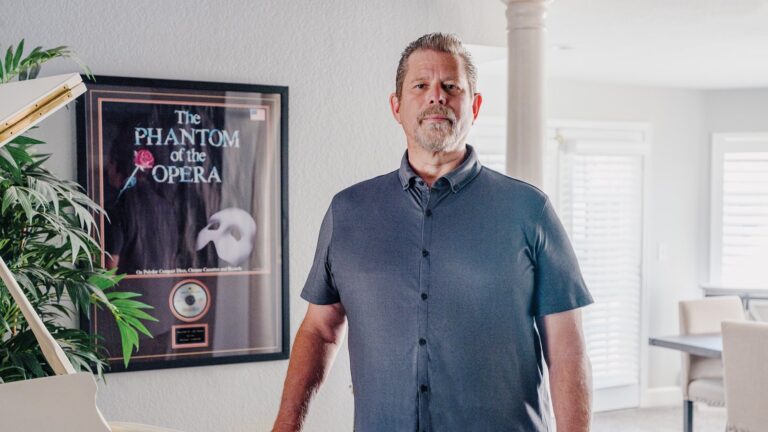
About 12 years ago, I was parked on a dark frontage road in the San Francisco Bay Area. It was about 9 p.m., and I had just finished helping another city’s narcotics team serve search warrants.

I was writing a letter to my wife—a suicide letter. I placed the notepad on the passenger seat and clipped my badge onto it. I cleaned my department-issued undercover car, removing the empty bags of fast food—a cop’s diet. (I didn’t want the responding officers to think I was a pig—no pun intended.) Then I pulled out my gun as I contemplated the most effective way to ensure a quick and painless death.

As a police officer for over 25 years, I had responded to calls that few could imagine, and I had investigated dozens of suicides. How had my life spiraled out of control to the point of wanting to commit one myself?

Suppressed emotions

I grew up in a middle-class family, working for my dad in his auto repair shop. I loved working on cars, but I didn’t want to do it for a living. One night, I went on a police ride-along. I loved it! I knew I had found my calling.

Police protect the thin line between good and evil. They witness the worst that Satan has to offer. The job requires the patience of a pastor, the wisdom of a judge, and the strength and stamina of a professional athlete. One minute, you are driving a patrol car eating donuts; the next, you’re chasing a burglar over fences. Few can endure the emotional stress and physical wear and tear.

I was taught at an early age to suppress my emotions. Looking back, I don’t know how I did it, but I was good at it. Never in a million years did I think that those emotions would surface at some point. Yet after 10 years, PTSD had taken hold. Outwardly 

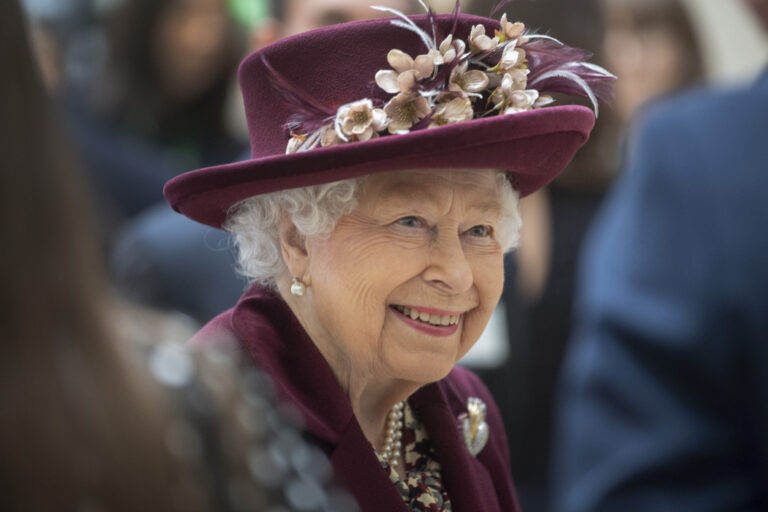
The Queen’s Christian faith in her own words

0

The Queen held the titles Supreme Governor of the Church of England and Defender of the Faith, but she had a personal and lifelong Christian faith that she often shared publicly. Here are some of the things she said about it over the years.

21st birthday address, 1947

“I declare before you all that my whole life whether it be long or short shall be devoted to your service and the service of our great imperial family to which we all belong. But I shall not have strength to carry out this resolution alone unless you join it with me, as I now invite you to do: I know that your support will be unfailingly given. God help me to make good my vow, and God bless all of you who are willing to share it.”

Christmas message 1981

“Christ not only revealed to us the truth in his teachings. He lived by what he believed and gave us the strength to try to do the same – and, finally, on the cross, he showed the supreme example of physical and moral courage.”

Christmas message 2002

“I know just how much I rely on my faith to guide me through the good times and the bad. Each day is a new beginning. I know that the only way to live my life is to try to do what is right, to take the long view, to give of my best in all that the day brings, and to put my trust in God!”

“I have been – and remain – very grateful to you for your prayers and to God for his steadfast love. I have indeed seen his faithfulness.”

Christmas message 2020

“The teachings of Christ have served as my inner light, as has the sense of purpose we can find in coming together to worship.”

Christmas message 2021

“…that in the birth of a child, there is a new dawn with endless potential. It is this simplicity of the Christmas story that makes it so universally appealing: simple happenings that formed the starting point of the life of Jesus — a man whose teachings have been handed down from generation to generation, and have been the bedrock of my faith. His birth marked a new beginning. As the carol says, ‘The hopes and fears of all the years are met in thee tonight.'”

Message to the Lambeth Conference, 2022

“Throughout my life, the message and teachings of Christ have been my guide and in them I find hope.”

India: Supreme Court orders government to verify reports of attacks on Christians

0

The highest court in India has ordered the government to provide details of reported attacks on Christians across eight states.

Christians are reported to have been targeted in Bihar, Chhattisgarh, Jharkhand, Odisha, Karnataka, Madhya Pradesh, Uttar Pradesh and Haryana.

At a hearing on 1 September, Supreme Court justices DY Chandrachud and Hima Kohli asked the Ministry of Home Affairs to verify the allegations.

The court order follows reports of Christians being attacked over 500 times in 2021 and the submission of a joint petition in March by the Archbishop of Bangalore, the National Solidarity Forum, United Christian Forum and Evangelical Fellowship of India calling for an end to the violence.

The Indian government responded to the reports by claiming that they were unfounded and “self-serving”.

Despite its rebuttals, the government has been ordered by the Supreme Court to establish the facts surrounding the reports and what response was made to the incidents.

A hearing has been scheduled for 6 December.

The Supreme Court’s intervention has been welcomed by Open Doors, a charity supporting persecuted Christians worldwide. 

Open Doors spokesperson Rinzen Baleng said: “Considering the government’s complete denial of the rising assaults on Christians in India, the Supreme Court’s order for further verification of the matter is a positive step.

“It’s critical for the outcome of case that the authorities furnish truthful and correct information in a time bound manner because it will help establish that these assaults are not just limited to few individuals but against the larger Christian community.”

Franklin Graham Criticises Pastoral Survey

0

The Cultural Research Center at Arizona Christian University released a shocking survey on May 10. The CRC administered a survey to 1,000 Christian pastors in the hopes of gaining a more in-depth understanding of their thoughts and behaviors.

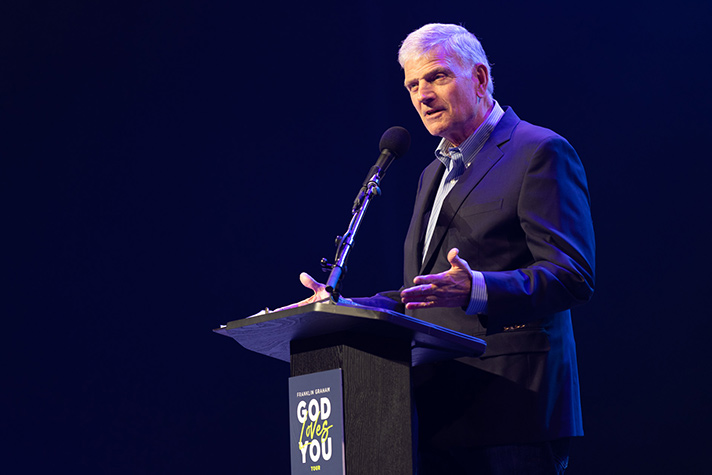
The discovery that only 37% of the pastors surveyed had a biblical worldview was enough to catch the attention of Franklin Graham.

“I don’t know which 1,000 pastors this group surveyed, but the results are concerning,” Graham tweeted.

Hungarian Evangelicals Thank God for Viktor Orbán Victory

Billy Graham Chaplains Welcome Ukrainian Refugees

“39% of ‘evangelical’ pastors they asked said there is no absolute moral truth & that ‘each individual must determine their own truth.’ What a lie.”

Graham also took issue with the result of 30% of the survey respondents do not believe that salvation was based on the confession of sins and accepting Jesus as Savior:

“The survey also said that 30% of evangelical pastors do not believe that their salvation is based on having confessed their sins & accepting Jesus Christ as their Savior. This kind of false teaching is what is leading people & churches astray.

“The Bible is God’s Word, from cover to cover. It is the absolute truth—it is what counts, not our opinion.”

91 Percent Of Churchgoers Say They’ll Return To Services After COVID-19, Poll Says

The survey shares a particularly disturbing comparison with the 37% of Christian pastors who hold a biblical worldview: only 2% of parents of preteens hold this view as well. These shockingly low numbers across the board give credence to Graham’s questioning of who exactly the participants were, and whether there was an agenda behind the survey

Rising christian artist Erin Corrado releases “Hiding Place” to encourage listeners going through hard times

Japan ordains first female bishop in east Asia

0

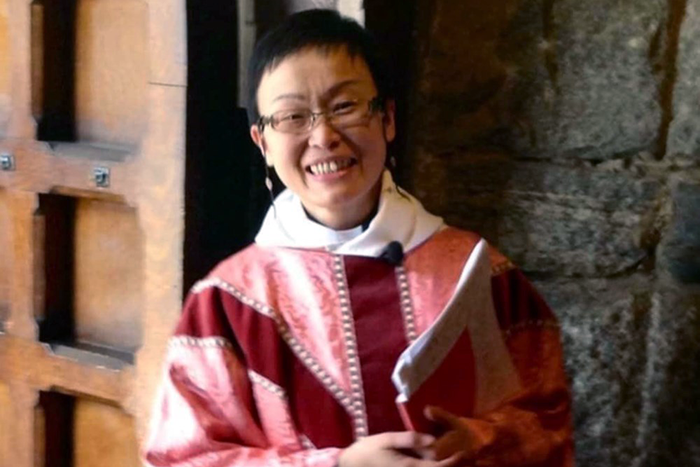
The Nippon Sei Ko Kei (NSKK), the Anglican Communion in Japan, is set to ordain Maria Grace Tazu Sasamorias Bishop of Hokkaido, making her the first female bishop in east Asia. 

The service will take place on Saturday 23 April at 10 am JST (1 am GMT) at the Cathedral Church of Sapporo Christ Church. It will be presided over by the Primate of the Nippon Sei Ko Kai, Bishop Luke Kenichi Muto of the Diocese of Kyushu. 

Covid restrictions means attendance is limited, but the service will be streamed live on the diocese website

Bishop-elect Maria Grace, a priest from the Diocese of Tokyo, was elected to her new role in November 2021, at the 80th Synod of the Diocese of Hokkaido. 

She is only the second female bishop in Asia, and the first in Japan and east Asia. 

Her election was welcomed at the time by Mandy Marshall, Director for Gender Justice at the Anglican Communion Office, as “a real breakthrough”. 

Marshall said the bishop-elect would “need our prayers as she steps into a very male space and has the pressure and holds the hopes of Anglican women in Japan”. 

The NSKK become a province of the Anglican Communion in 1972. It now comprises 11 dioceses with some 32,000 church members. 

Bishop-elect Maria Grace will succeed Bishop Nathaniel Makoto Uematsu, former Primate of the NSKK.

Anglican leaders around the world respond to the death of Queen Elizabeth II

0

Anglican leaders around the world have been paying tribute to the late Queen Elizabeth II, who died.

In addition to being Queen of the United Kingdom of Great Britain and Northern Ireland, Queen was also head of state of Antigua and Barbuda, Australia, the Bahamas, Belize, Canada, Grenada, Jamaica, New Zealand, Papua New Guinea, Saint Kitts and Nevis, Saint Lucia, Saint Vincent and the Grenadines, the Solomon Islands and Tuvalu.

Tributes were paid by Church leaders in some of the Queen’s overseas territories.

The Acting Primate of the Anglican Church of Australia and Archbishop of Melbourne, the Most Revd Philip Freier, said: “We remember with gratitude the grace with which she performed her duties, a steadfast and reassuring figure through decades of tremendous change and times of both hardship and joy.

“As frequent visitor to Australia the Queen had a special place in the hearts of Australians and she leaves behind a truly extraordinary legacy, having touched the lives of so many.”

The Archbishop of Canada, Primate of the Anglican Church of Canada, Linda Nicholls, said: “earlier this year, the Queen celebrated the Jubilee anniversary of her reign as monarch, having served with unstinting faithfulness in her responsibilities since 1952. She presided through those years with grace and dignity, rooted in her Christian faith and with love for all the people she served.”

Leaders of the four Anglican Churches in the British Isles also paid tribute.

The Queen was in Balmoral Castle, her Scottish home near the village of Crathie, which she had described as her “paradise in the Highlands” when she died. The Primus of the Scottish Episcopal Church, Bishop Mark Strange, said:

“The Queen came to the throne at a moment of great hope. A time of rebirth following the difficulties of war. She dedicated herself to the service of this country and she has honoured that pledge, especially so when things were difficult. She never wavered from her service.

“Queen Elizabeth was steadfast in her faith, in her prayers and worship. She spoke openly and often of her devotion to God, and to the Christian message of respect and the value of people, of all faiths and none.

“Here in Scotland we know that the Queen found space to relax and to be amongst family and friends, we cherish the knowledge that she loved this place as much as we do. That knowledge brought a shared connection that many of us felt deeply.”

The Archbishop of Canterbury and Primate of the Church of England, Archbishop Justin Welby, said: “as we grieve together, we know that, in losing our beloved Queen, we have lost the person whose steadfast loyalty, service and humility has helped us make sense of who we are through decades of extraordinary change in our world, nation and society.

“As deep as our grief runs, even deeper is our gratitude for Her Late Majesty’s extraordinary dedication to the United Kingdom, her Realms and the Commonwealth. Through times of war and hardship, through seasons of upheaval and change, and through moments of joy and celebration, we have been sustained by Her Late Majesty’s faith in what and who we are called to be.

“In the darkest days of the Coronavirus pandemic, The Late Queen spoke powerfully of the light that no darkness can overcome. As she had done before, she reminded us of a deep truth about ourselves – we are a people of hope who care for one another. Even as The Late Queen mourned the loss of her beloved husband, Prince Philip, we saw once again evidence of her courage, resilience and instinct for putting the needs of others first – all signs of a deeply rooted Christian faith.”

The Primate of the Church of Ireland, Archbishop of Armagh John McDowell, paid tribute to the Queen’s work in reconciliation. He said: “I was privileged to be there when, on her Diamond Jubilee visit to Enniskillen, she walked the 20 yards from the Church of Ireland Cathedral of St Macartin and into St Michael’s Roman Catholic church. Barely a hundred paces, but a walk which covered countless miles in the long and unfinished journey of peace on these islands.

“Her affection for Ireland as a whole was clear for all to see during the memorable State Visit to the Republic of Ireland in 2011, and her speech at the State Banquet ranks in political foresight and Christian conviction with the Golden Speech which Queen Elizabeth I made to the House of Commons in 1601. That in the past ‘we would have done things differently or not done them at all’ and that ‘we should bow to the past but not be bound by it’ have been little gems of hope to many peacemakers in the following years. That they came from someone who had felt the tragedy of Ireland so close to hand and who had lived through the uncertainties of a World War, when the outcome was often far from clear, gave her words an unchallengeable authority.”

The Governing Body, or synod, of the Church in Wales was meeting when Buckingham Palace issued statement regarding the Queen’s health. Members of the Governing Body prayed for the Queen and Royal Family and sang the national anthem, God Save The Queen, before adjourning their meeting early.

In the evening, after the announcement of the Queen’s death, the six Bishops of the Church in Wales issued a joint statement, saying that the news of the Queen’s death was received “with great sadness”

The Archbishop of Wales and Bishop of Bangor, Andrew John, along with Bishop Gregory Cameron (St Asaph), Bishop Joanna Penberthy (St Davids), June Osborne (Llandaff), Cherry Vann (Monmouth), John Lomas (Swansea and Brecon) and Mary Stallard (Assistant Bishop in Bangor), said:

“She endured through good times and bad, through celebrations and setbacks in the life of the nation. Whenever she was called upon to speak to the nation and the Commonwealth, she spoke in a way which reminded us of who we were, and called us to a greater response and more hopeful future. Born into privilege, she quietly transformed the monarchy so that it adapted itself in time. As a person, she typified an aspect important to national life, service for the greater good of all.

“We are particularly thankful to God for Her Majesty’s Christian witness. At Christmas, her broadcasts to the nation never failed to speak of her personal faith in Christ as Saviour. She commended love for God and one’s neighbour, and her life was lived in a way which quietly prioritised a commitment to Christian worship on a Sunday, and a regime of daily prayer. Like so much of her life, this was performed without display, but sincerely and with great devotion. This is an example of faith which we will hold dear.”

Other Anglican leaders also paid tribute.

The Primate of the Anglican Church of Southern Africa and Archbishop of Cape Town, Thabo Makgoba, said: “on behalf of the Anglican Church of Southern Africa, I send our heartfelt condolences to the British people and to all those in the Commonwealth for whom she was Head of State.

“May Queen Elizabeth II rest in peace and rise in glory. We send our greetings to the new King and his Consort, and pray that God will sustain him and his people in the days to come.”

The US-based Presiding Bishop and Primate of The Episcopal Church, Bishop Michael Curry, said:

“Today we mourn the passing and celebrate the life and legacy of Queen Elizabeth II. My prayers for peace go out for her, for her loved ones, and for all those who knew and loved her throughout the world.

“Her resilience, her dignity, and her model of quiet faith and piety have been – and will continue to be – an example for so many.”

The Secretary General of the Anglican Communion, Bishop Anthony Poggo, said: “The late Queen Elizabeth II had a deep personal faith in Jesus Christ which she was never afraid to share and talk about. She used her annual Christmas messages, televised around the world, as an opportunity to talk about the hope, peace and joy of the Gospel – a hope, peace and joy grounded in the realities of whatever difficulties people were facing at that particular time.

“She was Supreme Governor of the Church of England, but held the whole Anglican Communion of Churches in great esteem. Over the years, she looked forward to welcoming the bishops of the Communion to Buckingham Palace for a reception during Lambeth Conferences…

“I join with Anglican leaders around the world in thanking God for the Queen’s unstinting lifetime of service and faithfulness to Christ; and in offering my condolences and an assurance of prayers to King Charles III and the rest of the Royal Family.”

The Director of the Anglican Centre in Rome, the former Bishop of Mauritius and Primate of the Church of the Province of the Indian Ocean, Archbishop Iain Ernest, said: “The Anglican Centre in Rome wishes to express to members of the Royal Family and the people of the United Kingdom our heartfelt condolences as we mourn the loss of Queen Elizabeth II whose life has been totally dedicated to serve God and the people entrusted to her care with a steadfast faith. May her soul Rest In Peace and Rise in glory!”

Death of Queen Elizabeth II: Archbishop of Canterbury Justin Welby writes to Primates

0

The Archbishop of Canterbury, Justin Welby, has written to the Primates of the Anglican Communion and Moderators of the united Churches following the death of Queen Elizabeth II. The death of the Queen was announced by Buckingham Palace at 6.30pm BST (5.30 pm GMT) this evening (Thursday).

In his letter, Archbishop Justin praised the late Queen as “a faithful Christian disciple”, and said: “Her Late Majesty lived out her faith every day of her life. Her trust in God and profound love for him was foundational in how she led her life – hour by hour, day by day.

“In Her Late Majesty’s life we saw what it means to receive the gift of life we have been given by God and – through patient, humble, selfless service – share it as a gift to others.

“Her Late Majesty found great joy and fulfilment in the service of her people and her God ‘whose service is perfect freedom’ (BCP). For giving her whole life to us, and allowing her life of service to be an instrument of God’s peace among us, we owe Her Late Majesty a debt of gratitude beyond measure.”

The full text of Archbishop Justin’s letter follows:

8 September 2022

To Primates of the Anglican Communion & Moderators of the United Churches

Your Graces,

It is with deep sadness that I write this letter to you, on the death of Her Majesty Queen Elizabeth II.

Her Late Majesty was not only Queen of The United Kingdom but was also Queen and Head of State of 15 other nations – territories served by many provinces of our Anglican Communion.

Through her annual Christmas messages to the Commonwealth, we heard, in her own words, Her Late Majesty’s witness to her strong Christian faith.

As Supreme Governor of the Church of England, and as a faithful Christian disciple, Her Late Majesty lived out her faith every day of her life. Her trust in God and profound love for him was foundational in how she led her life – hour by hour, day by day.

In Her Late Majesty’s life we saw what it means to receive the gift of life we have been given by God and – through patient, humble, selfless service – share it as a gift to others.

Her Late Majesty found great joy and fulfilment in the service of her people and her God “whose service is perfect freedom” (BCP). For giving her whole life to us, and allowing her life of service to be an instrument of God’s peace among us, we owe Her Late Majesty a debt of gratitude beyond measure.

Her Late Majesty leaves behind a truly extraordinary legacy: one that is found in almost every aspect of our national life, as well as the lives of so many nations around the world, and especially in the Commonwealth.

I ask you to join me in prayers for the Royal Family, and especially for the new King.

Pray too for the people of all the countries in His Majesty’s realms and territories: Antigua and Barbuda, Australia, The Bahamas, Belize, Canada, Grenada, Jamaica, New Zealand, Papua New Guinea, Saint Kitts and Nevis, Saint Lucia, Saint Vincent and the Grenadines, Solomon Islands, Tuvalu, and the United Kingdom of Great Britain and Northern Ireland.

And may I humbly ask you to pray for me, too: that God will strengthen, guide and support me in my duties at this time of mourning; as I assure you, too, of my continuing prayers for you all; and especially for the provinces which serve areas included in Her Late Majesty’s realm and territories.

In the peace of Christ
+Justin Cantaur

The Most Reverend and Right Honourable Justin Welby
Archbishop of Canterbury
Lambeth

Traditional Methodists Search for New Path Forward |

0

MARK TOOLEY

The 13-million-member United Methodist Church is shattering, and traditionalists are building a new Global Methodist Church committed to theological and ethical Christian orthodoxy. Are the new wineskins of a new denomination preferable to remaining a faithful witness within an old denomination?

There are pluses and minuses to each, and neither offers a straight and smooth path.

Traditionalists of other mainline Protestant denominations have faced similar situations in recent years. Official endorsement of liberal teachings on sexuality persuaded some conservatives in the Evangelical Lutheran Church, Presbyterian Church (USA), and Episcopal Church to create new denominations or join other preexisting denominations. Episcopalians formed the Anglican Church in North America, which has nearly 1,000 congregations and 127,000 members. Presbyterians joined the Evangelical Presbyterian Church, with 630 churches and 130,000 members, or created the Evangelical Covenant Order, with nearly 400 congregations and 130,000 members. Lutherans created the North American Lutheran Church, which now has about 142,000 members and more than 420 congregations.

Those Leaving and Those Left Behind

Progressives may have expected growth after conservatives left. After all, conflict was ended, restrictions were overthrown, the church was now open to “all.” But this never happened. Churches offering only affirmation, without expectations or the possibility of transformation, haven’t commanded loyalty or made new converts.

About 5 percent of the membership in old, liberalized denominations joined the new conservative denominations. But each of the old denominations has lost many more members since liberalizing. For example, the Presbyterian Church (USA) since its 2013 affirmation of actively homosexual clergy has lost over half a million members—about one-third of its membership. Since its 2009 sexual liberalization, the Evangelical Lutheran Church has lost more than 1 million members—about one-quarter of its membership. The Episcopal Church, since electing its first openly homosexual bishop in 2003, has lost over half a million members—about one-quarter of its membership.

Churches offering only affirmation, without expectations or the possibility of transformation, haven’t commanded loyalty or made new converts. 

New denominations have largely done well but didn’t initially attract as many conservatives from the old denominations as had been expected. Inertia and commitment to the easier status quo can be powerful. The Anglican Church of North America has planted several hundred new congregations, most—but not all—of which have survived. New denominations have their own theological, political, and personal conflicts, as do all human institutions. People expecting perfection in a new “orthodox” church will be disappointed.

But conservatives who stayed in old liberal denominations expecting their witness could have a wider influence are likely also disappointed. Liberalized denominations show no signs of denomination-wide renewal. The influence of LGBT+ messages continues to grow.

Still, some congregations and clergy adhere to Christian orthodoxy and survive as a minority witness. We can pray their subculture endures. Liberal Protestantism will not survive forever, and perhaps in another generation or two, the embers of Christian orthodoxy will reignite in the small remnant of mainline Protestantism.

Odd Case of Methodism

Unlike most mainline denominations, United Methodism has never officially liberalized its teachings on sexuality and instead strengthened them at its last governing General Conference in 2019 by a 53 percent majority. This was possible only because its membership is international, with nearly half in Africa at that time, where beliefs are very conservative. As the American church shrinks and the African church grows, the conservative majority will only expand.

So why would American United Methodist traditionalists now leave for the newly created Global Methodist Church? Liberals control every position of power within the U.S. part of the church, and U.S. bishops increasingly refuse to uphold church law defining marriage as only between a man and a woman. Twelve of United Methodism’s 13 official seminaries are theologically and ethically liberal. All general church agencies are liberal.

Liberal Protestantism will not survive forever, and perhaps in another generation or two, the embers of Christian orthodoxy will reignite in the small remnant remaining of mainline Protestantism. 

A chief challenge for Global Methodism—as for all new denominations—is that American Christians are less interested in denominations, less catechized in denominational teaching, and less interested in sustaining wider institutions. They’re attracted to specific congregations, clergy, and ministries that may or may not last very long.

Amid this upheaval, creating a new denomination will be hard work.

But there’s arguably no other viable path forward for traditional Methodists who want to cleave to and extol orthodox Wesleyan beliefs about Christ, salvation, morality, and the Bible. Historic Methodist beliefs about sanctification, holiness, and perfection have been almost forgotten. The situation in the old United Methodist Church in America will only worsen as liberals insist on a gospel of affirmation. Traditionalists want a gospel of salvation and transformation. These two perspectives ultimately cannot coexist in the same denomination. There can be Christian unity across doctrinal and ethical nonessentials, but the divisions between traditionalists and progressives in mainline Protestantism are unbridgeable.

Some United Methodist leaders insist traditionalists will be welcome even after the denomination jettisons biblical sexual teaching. Traditionalists wonder how this can be so when progressives insist traditional teaching is intrinsically exclusionary and unacceptable.

Hope for the Future

Methodist traditionalists hope, through the Global Methodist Church, to plant new congregations and replant Methodism where it has died. For the first time, church planters will have denominational support for evangelizing unreached peoples. The fields are white for harvest (John 4:35). But of course, there’s no guarantee of success. Global Methodism could become just another small conservative American sect that’s generically evangelical.

Other new denominations face the same question: Can they hold onto the unique goodness and strength of their traditions while simultaneously separating from their denominational structure and educational institutions? It’s still too early to tell.

I hope Global Methodism will connect American Wesleyans with African Wesleyans and others around the world in proclaiming a gospel of salvation, transformation, sanctification, holiness, and perfection. This gospel fueled the original 18th and early 19th-century Methodist revivals and is fueling church growth in Africa. God willing, it could thrive in America.

Mark Tooley is president of the Institute on Religion and Democracy and editor of the foreign policy and national security journal Providence.

5 New Stats You Should Know About Teens and Social Media

0

By Chris Martin

How often does your teen use social media? What social media platforms are most popular among the students in your student ministry?

Probably a lot, and probably YouTube and TikTok, according to a new survey from Pew Research Center.

We know why this matters for teens—we can see how they’re being discipled through their relationship with social media.

But it also matters for the rest of us, because how teens use social media often drives how everyone uses social media. At nearly every turn in the young life of the social internet, teenagers have led the way. Whether or not a new app catches on often depends on the adoption rate among teen social media users. The kinds of content that lead to cultural phenomena off-line are often created and promoted by teen social media users.

In order to best love and lead the teens in our lives—whether they’re our children, in our student ministries, or otherwise in our care—we’d be wise to know how they use social media and other forms of technology. Let’s look at a handful of stats that provide a clearer picture of how these forms of media may be shaping teenagers.

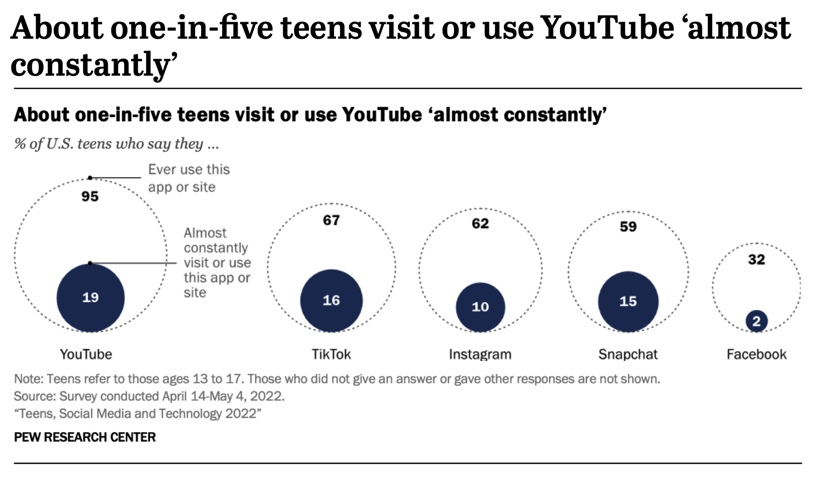
1. 95 percent of teens use YouTube, and 19 percent use it ‘almost constantly.’

While YouTube feels much more like a TV replacement than a traditional social media platform (like Facebook or Instagram), it’s undeniably social media.

And YouTube is dominant across the board, regardless of the users’ age, gender, race, socioeconomic status, or otherwise, Pew found. Almost all teens use YouTube, nearly one in five “almost constantly.”

It’s not hyperbolic to say that YouTube is the most influential—and, therefore, the most important—website in the world. It’s used by almost every single teen in the country, and as of Pew’s latest research of U.S. adults in 2021, it’s also used by 81 percent of all adults. YouTube is king of the social media world, but it isn’t just that. It’s also the second largest search engine in the world, surpassed only by Google, its sister company in the Alphabet family.

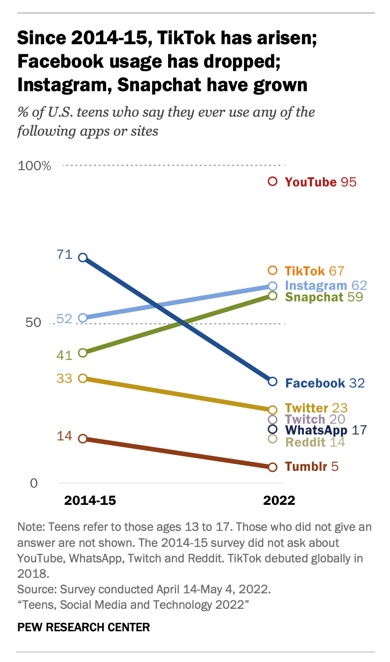
2. 67 percent of teens use TikTok, compared to 62 percent who use Instagram and 59 percent who use Snapchat.

This is perhaps the most shocking statistic in the whole study, aside from the stat that shows 95 percent of U.S. teenagers have a smartphone (up from 73 percent in 2014–15). No one should be surprised at TikTok’s popularity—it drives culture more than any other social media app right now—but you might be surprised at how quicklyit has overtaken the attention share of two social media mainstays among teenagers: Instagram and Snapchat. When Pew did this survey six years ago, TikTok hadn’t even been created yet.

While both Instagram and Snapchat’s usage among teens has jumped significantly since 2014–15 (10 percent and 18 percent respectively), it’s notable that TikTok is making its debut ahead of those two platforms.

Of course, there are plenty of reasons to be concerned about TikTok, from its addictive algorithm to its relationship with the Chinese government. But its appeal is undeniable. As someone whose favorite social media app of all time is Vine, I found TikTok fills the short-form video void that was left when Twitter shuttered Vine in January 2017. Also worth noting is that when Pew conducted their last survey on teens and social media in 2014–15, Vine was only corralling the interest of 24 percent of U.S. teenagers, which pales in comparison to TikTok’s 67 percent.

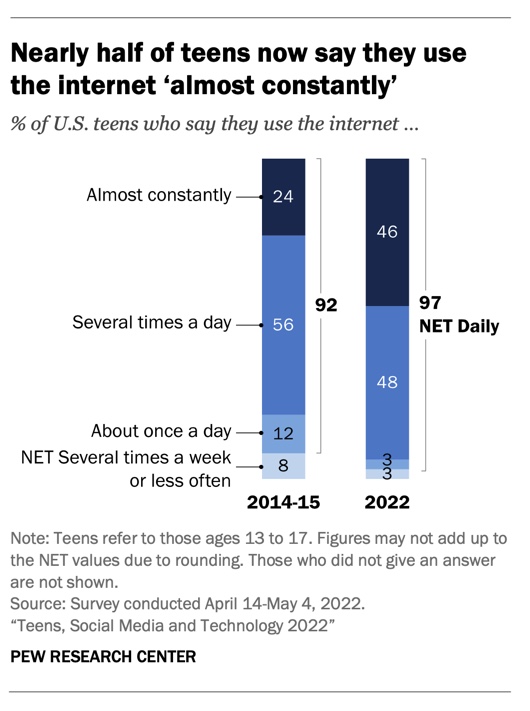
3. 46 percent of teens say they use the internet ‘almost constantly.’

It seems as if teenagers are always online. Of course, some of this time may be related to a work or school obligation of some sort. However, other studies have shown that teens average more than seven hours a day on screen entertainment; about 60 percent spend more than four hours a day on social media alone.

Because they’re always online, teenagers are “always in the hallway,” Derek Thompson writes in his book Hit Makers. The social internet is the modern version of a school hallway and lunchroom—a stage that’s ever-present and unrelenting in its demands for performance under the hot lights of social pressures.

Teens, then, are enslaved to performance. It is no wonder students struggle with anxiety and depression in greater numbers than ever.

4. 36 percent of teens say they spend ‘too much’ time on social media.

While 46 percent of teens say they’re “almost constantly” online, and another 48 percent say they’re on the internet “several times a day,” only 36 percent of teens say they spend “too much” time on social media.

An interesting related statistic shows that older teens (those aged 15–17), are more likely to report they spend too much time on social media than younger teens (those aged 13–14). Forty-two percent of older teens think they spend too much time on social media, while just 28 percent of younger teens think the same. It’s hard to know why this is the case. It could be that younger teens are spending less time on social media or that older teens are more attuned to how much social media is “too much.”

5. Only 32 percent of teens use Facebook, compared to 71 percent of teens in 2014–15.

This was the least surprising statistic to me, but it’s nonetheless notable. The behemoth of Silicon Valley whose “move fast and break things” mantra has led it to be more like a bull in a china shop is hemorrhaging teenage users. Of course, Facebook knows this more intimately than anyone. It’s why they purchased Instagram out of the bargain bin for a billion dollars in 2012 (it was estimated to be worth $100 billion in 2018) and why they tried to buy Snapchat for $3 billion in 2013 (Snapchat rejected the offer and is now worth around $17 billion).

Meta, the holding company of Facebook, Instagram, and WhatsApp, knows it’s losing young users from its flagship platform, Facebook. And it risks the same with Instagram as it repeatedly tweaks the app to compete with TikTok, at the cost of frustrating its users.

Force of Discipleship

Social media is likely the greatest force of discipleship among the teens in your home and in your church. Parents and church leaders understandably feel overwhelmed when they consider the prospect of discipling in competition with the omnipresent internet and its carnival of fancies. What can you do, then, as a parent or ministry leader?

First, you have to be willing to change your own habits. The average social media user spends about two and a half hours per day on social media—that’s not just teenagers, that’s everyone. If you and I are going to help the teenagers in our lives have a more healthy relationship with social media, we need to be willing to evaluate our own. The Pew research clearly shows that social media is a teen issue, but it’s not onlya teen and student ministry issue. We ought to check our own lives before we instruct the teens in our care.

If you and I are going to help the teenagers in our lives have a more healthy relationship with social media, we need to be willing to evaluate our own. 

Second, you can’t go wrong with emphasizing the importance of living life off-line. A significant percentage of teens recognize their unhealthy relationship with social media, or at the very least see how the internet is affecting their peers. How we do this is important—celebrating the richness of off-line life is more likely to resound with teens than chastising them for spending so much time online. Discipling teenagers who are always online doesn’t require us to force them off-line, but it does require us to show them that the best of life is away from their feeds and apart from their screens.

Finally, we must model what it means to be the embodied church. The teenagers in your home or church may not yet be believers. If we want to show them a better way—the best way—to find community and meaning, we need to model what it looks like to do that in the embodied church and the God we worship. Practically, this looks like involving teenagers in all aspects of church life, from personal Bible reading to the local church worship gathering to community groups and more.

Attempting to disciple a teenager in the age of the internet can feel like trying to put out a raging house fire with a pocket-sized squirt gun. But by God’s grace, we get to rely on living water and wells of grace that never run dry.

Chris Martin is a content marketing editor at Moody Publishers and a social media, marketing, and communications consultant. He writes regularly in his Substack newsletter, Terms of Service, and author of Terms of Service: The Real Cost of Social Media (B&H, 2022). Chris lives outside Nashville with his wife, Susie, their daughter, Magnolia, and their dog, Rizzo.

thegospelcoalition.org

President of Israel Thanks Kenneth Copeland Ministries for Helping Ukrainian Jews Make Aliyah

0

On Wednesday, Aug. 17, 2022, the President of Israel, Isaac Herzog, personally called Kenneth Copeland and Pastors George and Terri Pearsons to express his thanks and appreciation for the significant work Kenneth Copeland Ministries and Eagle Mountain International Church have done to help Ukrainian Jews make Aliyah amid the Russia/Ukraine war.

In partnership with Keren Hayesod United Israel Appeal, the Partners of Kenneth Copeland Ministries and the congregation of Eagle Mountain International Church have helped more than 30,000 Ukrainian Jews make Aliyah by contributing more than $8 million this year alone. This is the most significant financial offering the ministry has sown into other outreaches in its 55-year history.

The finances are used to not only bring Ukrainian Jews out of harm’s way and into Israel, but they are used to meet practical needs, including housing, clothing, integration and vocational training.

During the call, Brother Copeland was able to share with President Herzog why the ministry is committed to supporting Israel and the Jewish people:

“We are Jewish because we want to be. We stand strong in covenant with this nation, and we stand on Genesis 12…

Get out of your country, from your family and from your father’s house, to a land that I will show you. I will make you a great nation; I will bless you and make your name great; and you shall be a blessing. I will bless those who bless you, and I will curse him who curses you; and in you all the families of the earth shall be blessed. So Abram departed… (verses 1-4, New King James Version).

“That’s the family we’re a part of.”

The Israeli president went on to express his appreciation and thank the Partners of Kenneth Copeland Ministries and the Eagle Mountain International Church congregation for their generous support of the Jewish people:

“I’m extremely honored to speak to you and congratulate you…for being such staunch friends of the state of Israel and believing in the state of Israel and its unique destiny….”

Kenneth Copeland Ministries

Kcm.org